From Socrates to Manipur: Majoritarianism, Minority Rights, and the Crisis of Constitutional Democracy in India
Dr. Gurinder Singh Grewal
August 22,20.26
Introduction
The execution of Socrates in Athens in 399 BCE endures as one of history’s most powerful warnings about the dangers of democracy unchecked by robust protections for dissent. Socrates faced charges of impiety—including failing to honor the gods recognized by Athens—and of corrupting the youth. A citizen jury, wielding the authority of the majority, convicted him and sentenced him to death by hemlock.
The enduring significance of his death is not simply that an innocent or unconventional philosopher was killed. It is that democratic institutions themselves participated in the process. The majority possessed legal authority, but legal authority did not necessarily produce justice.
For religious and political minorities in contemporary India, the Socratic question is therefore not merely historical:
What happens when the identity, beliefs, fears, or prejudices of a dominant community acquire sufficient political power to weaken the protection of those who dissent or belong to minorities?
The lived realities of Muslims, Sikhs, Christians, and other minorities in India offer sobering evidence for examining that question. The anti-Sikh violence of 1984, the Punjab disappearances investigated by Jaswant Singh Khalra, the Gujarat violence of 2002, the Delhi communal violence of 2020, the controversies surrounding citizenship policy, and the catastrophic violence in Manipur since 2023 all unfolded under different governments and circumstances. These episodes should not be reduced to a single conspiracy or pinned solely on one political party.
Yet taken together, they illuminate a recurring constitutional dilemma: What transpires when state institutions fail to protect minorities—or are credibly accused of aligning with the interests, prejudices, or political imperatives of the dominant community?
That is where Socrates meets Ambedkar, and where ancient Athens becomes relevant to modern India.
Socrates: When Democracy Fails the Dissenter
Socrates did not command an insurgency against Athens. His principal weapon was questioning.
He questioned assumptions about virtue, religion, justice, knowledge, and political authority. Yet Athens ultimately treated this questioning as sufficiently threatening to justify prosecution.
His fate demonstrates an essential distinction:
Democracy is not synonymous with justice.
A majority can vote.
A legislature can enact a law.
A government can act according to established procedure.
A court can pronounce judgment.
And nevertheless, an injustice can occur.
Socrates thus represents the solitary individual, standing in principled opposition before the organized authority of society.
His famous moral position was even more demanding: it is worse to commit injustice than to suffer it. In Plato’s Crito, he refuses to answer injustice with injustice.
Socrates died physically, but Athens has carried the moral burden of his execution for more than two thousand years.
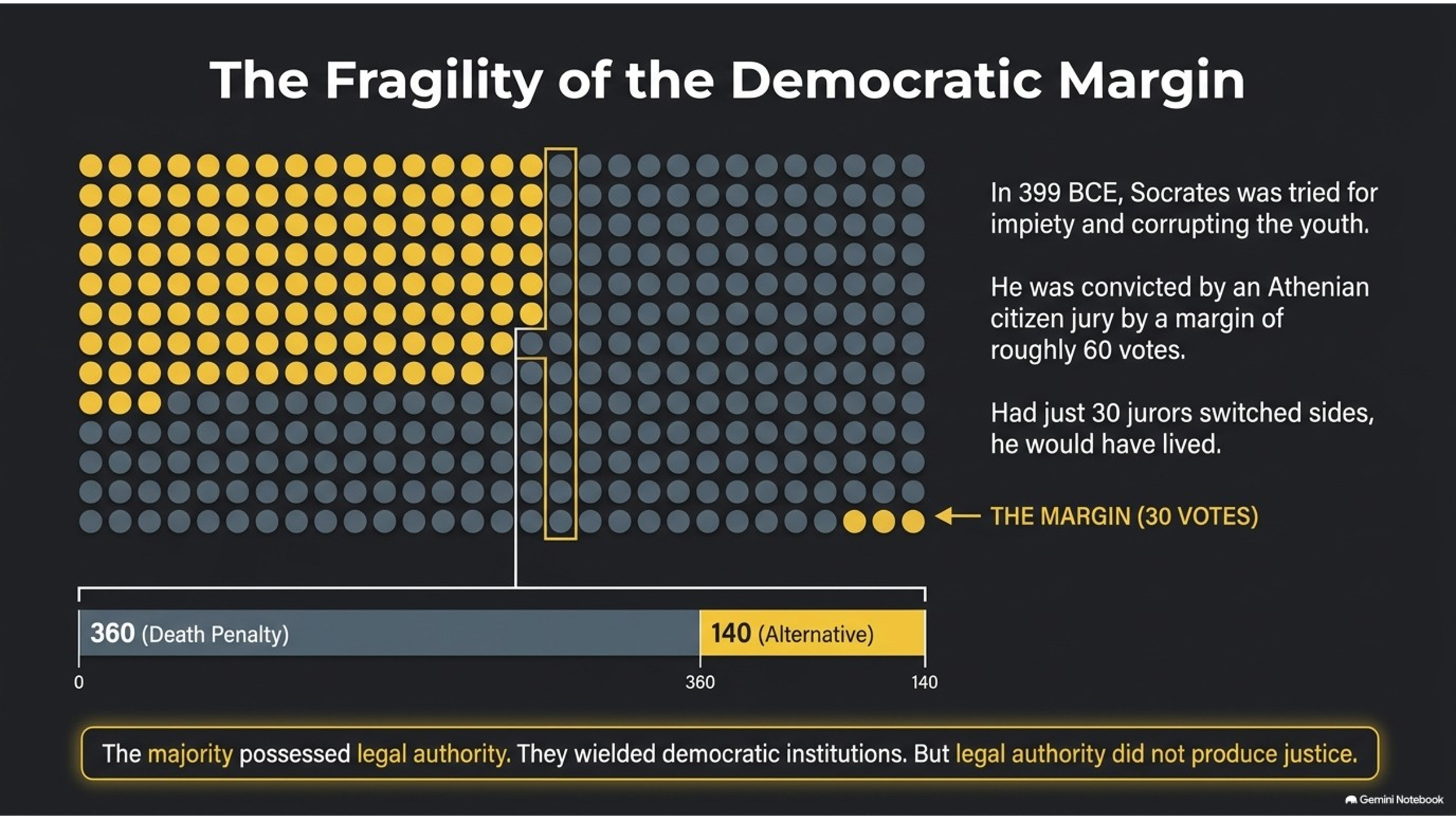
Plato does not provide exact totals; the figures are reconstructed from his remarks and later ancient sources. Plato’s Apology
Ambedkar Understood the Indian Version of the Problem
Dr. B. R. Ambedkar identified a danger particularly relevant to India: the difference between a political majority and a communal majority.
The political majority is temporary. Citizens can create it at one election and destroy it at another.
A communal majority based upon religion, caste or inherited social identity can become effectively permanent.
Ambedkar warned explicitly against allowing a communal majority to assume the unrestricted powers normally associated with a political majority. He described the potential result as the “tyranny of that majority.”
In a 1946 Scheduled Castes Federation resolution, the problem was stated even more directly: political independence should not merely liberate the majority from colonial rule while leaving minority communities exposed to domination by a permanent communal majority.
This distinction is crucial.
If Hindus constitute a durable national majority, Muslims cannot simply become the religious majority at the next election.
Neither can Sikhs.
Neither can Christians.
Therefore, constitutional protections cannot depend upon the generosity of the majority.
They must operate against the majority when necessary.
That is the purpose of fundamental rights.
- 1984: When Sikhs Became the Target
The assassination of Prime Minister Indira Gandhi by two Sikh bodyguards on October 31, 1984, was followed by horrific organized violence against Sikhs, particularly in Delhi.
Sikh men were murdered, homes and businesses were attacked, and gurdwaras were burned. The subsequent struggle for accountability lasted decades.
One of the most significant cases involved Congress politician Sajjan Kumar. The Delhi High Court sentenced him to life imprisonment in 2018 for his role in killings during the 1984 violence and the burning of a gurdwara. In another case, he was convicted in 2025 in connection with the killings of Jaswant Singh and his son Tarundeep Singh.
The historical significance extends beyond the guilt of particular individuals.
The central constitutional question is:
How could citizens belonging to one religious community become so vulnerable in the capital of their own country?
A Sikh did not cease to be an Indian citizen because the assassins of the prime minister happened to be Sikh.
Collective punishment contradicts the very foundation of constitutional citizenship.
The lesson of 1984 is therefore larger than Congress, the BJP, or any other political organization.
When the individual is subsumed by communal identity, the very foundation of citizenship is imperiled.
- Jaswant Singh Khalra: The Socratic Dissenter in Punjab
Perhaps no modern Sikh figure illustrates the Socratic principle more powerfully than Jaswant Singh Khalra.
During the Punjab insurgency and counterinsurgency, allegations accumulated concerning disappearances, extrajudicial killings, and unidentified cremations.
Khalra investigated cremation records and attempted to document what had happened to people who had disappeared.
He was not carrying a weapon.
He was searching for records.
He was asking a profoundly Socratic question:
What happened to the missing?
That question challenged institutions possessing enormous coercive power.
Khalra was abducted in 1995 and killed in police custody. Subsequent judicial proceedings resulted in convictions of police personnel. His investigations into alleged illegal cremations also came under scrutiny by the CBI and the judiciary. Contemporary examination of the legal record describes Khalra as having exposed the issue of Punjab’s “disappearing” men before his own abduction and custodial death.
The parallel with Socrates is compelling.
Socrates questioned Athens.
Khalra questioned the state.
Socrates could have preserved himself by abandoning his principles.
Khalra reportedly understood the danger of continuing his investigation but continued, nevertheless.
The central lesson is not simply that both men died.
It is that truth becomes perilous when institutions fear those who ask uncomfortable questions more than the injustice that those questions reveal.
Khalra’s case also prevents the argument about Indian majoritarianism from becoming narrowly partisan. His killing occurred in Punjab under a Congress government, not under today’s BJP government.
That historical fact is essential.
Majoritarianism and abuse of state power are structural dangers, not the monopoly of one political party.
A credible defense of minority rights must condemn the persecution of Sikhs under Congress governments just as firmly as discrimination against Muslims or Christians under BJP governments.
III. Gujarat 2002: The Muslim Question
The Gujarat violence of 2002 constitutes another major episode in the history of communal relations in modern India.
The violence followed the burning of a train coach at Godhra in which Hindu passengers were killed. The retaliatory communal violence that followed devastated Muslim communities, although Hindus were also among those killed.
The political and legal controversies surrounding responsibility, police conduct, prosecutions and political accountability continued for years.
For purposes of the Socratic argument, the important principle is not collective guilt.
It is precisely the opposite.
No Muslim citizen becomes responsible for a crime merely because another Muslim committed it, just as no Sikh became responsible for Indira Gandhi’s assassination merely because her assassins were Sikh.
Constitutional government truly begins when individual accountability supplants communal retaliation.
- Citizenship and the Muslim Minority
The Citizenship Amendment Act produced another form of controversy.
Unlike episodes of mass violence, this dispute concerns the relationship between religious identity and citizenship policy.
Human Rights Watch and other critics argued that the citizenship framework discriminated against Muslims because the legislation created a path to citizenship for specified non-Muslim religious minorities from Pakistan, Bangladesh and Afghanistan while excluding Muslims from that particular expedited route. The Indian government has rejected the contention that the CAA removes citizenship from Indian Muslims and maintains that the law provides refuge to persecuted minorities from neighboring countries.
Both propositions need to be recognized in serious scholarship.
But the constitutional question remains profound:
Should religion determine differential access to citizenship?
Once citizenship and religious identity become intertwined, Ambedkar’s warning about a permanent communal majority becomes especially relevant.
- Delhi 2020: When Communal Politics Enters the Street
Communal violence erupted again in Delhi in February 2020 amid protests over citizenship legislation.
More than fifty people were killed and hundreds injured. Hindus were also among the dead, including a police officer, but Muslims constituted the majority of victims according to contemporary reporting. Muslim homes, businesses and mosques were attacked.
Especially serious were allegations concerning police conduct.
Human Rights Watch reported witness accounts and other evidence alleging police inaction, complicity or participation in abuses against Muslims. Delhi Police disputed accusations of communal bias and defended its response.
Again, the relevant question is larger than identifying which community began a particular confrontation.
In a constitutional democracy, the police do not belong to Hindus, Muslims, Sikhs, Christians or any political party.
They belong to the constitutional state.
When a minority citizen looks at a police officer during communal violence, that citizen must see a protector rather than wonder which religious community the officer favors.
When that confidence disappears, constitutional government itself has suffered an injury.
- Manipur: Athens on a Much Larger Scale
Manipur provides perhaps the most disturbing contemporary illustration.
The violence beginning in May 2023 arose from a complicated mixture of ethnic, political, territorial and constitutional disputes, particularly involving predominantly Hindu Meiteis and predominantly Christian Kuki-Zo communities.
It would therefore be inaccurate to describe the conflict simply as Hindus attacking Christians.
People from multiple communities suffered.
Yet the scale of the catastrophe is undeniable.
By November 2023, reporting cited by the U.S. State Department recorded at least 175 deaths and more than 60,000 displaced persons. There were reports of killings, sexual violence, assaults, and destruction of homes, businesses, and places of worship. The report also noted that India’s Supreme Court criticized the central and state governments’ failures to stop the violence and to intervene in investigations, humanitarian assistance, and reconstruction.
Here the Socratic analogy becomes larger.
Athens failed Socrates.
In Manipur, institutional failure affected the entire population.
Men and women were killed.
Women suffered appalling sexual violence.
Families fled ancestral homes.
Communities became geographically separated.
Places of worship were destroyed.
Tens of thousands became displaced within their own country.
The victims were Indian citizens.
Their constitutional rights existed on paper.
But constitutional rights are hollow to a family fleeing violence if the state cannot make those rights real and effective on the ground.
This is where Manipur becomes Athens multiplied thousands of times—not because the historical events are identical, but because the fundamental moral question is the same:
Can democratic institutions protect the vulnerable when communal passions overwhelm ordinary constitutional restraints?
VII. RSS, BJP and Hindu Majoritarianism
The rise of the BJP and the ideological influence of the RSS make this question particularly important today.
Supporters of Hindutva describe it as civilizational restoration, cultural self-confidence and national integration after centuries of foreign domination. They argue that acknowledging India’s Hindu civilizational inheritance does not require mistreating minorities.
That argument deserves to be represented accurately.
But critics raise a different and fundamental question:
Can a state remain equally the possession of all citizens if national identity becomes increasingly associated with the religion and culture of its permanent majority?
That is the problem with Ambedkar.
If “Indian” gradually becomes culturally synonymous with “Hindu,” the constitutional status of the Muslim, Sikh or Christian may remain formally equal while their psychological and political position changes.
The minority citizen can gradually be transformed from an equal owner of the Republic into a person whose loyalty is repeatedly expected to be demonstrated.
This transformation encapsulates the essence of majoritarianism.
VIII. The Pattern Extends Beyond BJP and RSS
Historical integrity requires an important qualification.
The anti-Sikh violence of 1984 occurred under Congress rule.
Jaswant Singh Khalra was abducted and murdered during a Congress government in Punjab.
The 2002 Gujarat riots occurred under the BJP government.
Delhi 2020 occurred while the BJP was in power nationally.
The Manipur catastrophe began under BJP governments at both the state and central levels.
These histories should not be manipulated to prove that only one political organization is capable of injustice.
The deeper problem is unrestrained political power combined with communal identity and institutional weakness.
Congress must answer for historical injustices committed under Congress governments.
The BJP must answer for actions and failures occurring under BJP governments.
No party should be permitted to use the crimes of its opponent to erase its own responsibilities.
Human rights must remain inviolable, regardless of which government holds power.
Otherwise, they are political weapons rather than principles.
- From Socrates to Khalra
There is an extraordinary philosophical connection between Socrates and Jaswant Singh Khalra.
Neither became historically important because he possessed governmental power.
Their power came from asking questions.
Socrates asked:
What is justice?
Khalra effectively asked:
Where are they disappeared?
The authorities could silence the men.
They could not permanently silence their questions.
That is why the death of a dissenter can ultimately become more damaging to the state than the dissenter’s original criticism.
Athens killed Socrates but could not defeat his philosophy.
Punjab Police personnel killed Khalra, but his death ensured that the question of disappearances would travel far beyond Punjab.
The state may possess coercive power.
The dissenter possesses memory.
And sometimes memory outlives the state officials who attempted to suppress it.
- Sikh Philosophy and the Defense of the Other
Sikh thought adds another dimension to this discussion.
The Sikh tradition does not limit justice to the protection of Sikhs.
Guru Tegh Bahadur’s martyrdom occupies a unique place in Sikh consciousness precisely because it symbolizes the defense of another community’s freedom of conscience.
That principle provides a powerful ethical foundation for contemporary Sikh political thought.
A Sikh cannot credibly demand justice for 1984 while remaining indifferent to injustice against Muslims.
A Muslim cannot defend Muslim minority rights while dismissing what happened to Sikhs.
A Hindu committed to constitutional democracy cannot excuse violence against Muslims or Christians because perpetrators claim to act for Hindu interests.
A Christian cannot demand religious liberty only for Christians.
The instant human rights are reduced to tribal claims, they cease to be human rights at all.
- Majority Rule Is Not Majoritarian Rule
There is an essential distinction between majority rule and majoritarianism.
Majority rule is necessary for democracy.
Majoritarianism occurs when the majority begins to believe that winning elections gives it a superior claim upon the nation itself.
Under constitutional democracy:
The majority receives the right to govern.
It does not receive the right to determine who belongs.
It cannot determine which religion deserves greater citizenship.
It cannot transform dissent into disloyalty.
It cannot make minority rights dependent upon majority approval.
This distinction forms the constitutional bulwark separating democracy from communal domination.
XII. The Socratic Test for India
India should therefore be judged by a more demanding standard than the mere regularity of elections.
Ask instead:
Can a Muslim criticize the government without his religion becoming relevant?
Can a Sikh advocate greater autonomy for Punjab without automatically being suspected of disloyalty?
Can a Christian practice and propagate the faith within constitutional limits without fear?
Can a Hindu criticize Hindutva without being regarded as anti-Hindu?
Can journalists investigate state abuse?
Can human-rights defenders document disappearances without becoming targets themselves?
Can a Kuki family and a Meitei family both expect the same protection from the state?
Can the smallest minority stand before the government with the same constitutional dignity as the largest majority?
If the answer to these questions is yes, constitutional democracy is functioning.
Where the answer becomes no, the shadow of Athens begins to appear.
Conclusion: Athens Is a Warning, Not Merely a Place
Socrates died more than twenty-four centuries ago, but Athens is not merely a geographical location or historical period.
Athens represents a political condition.
Athens appears whenever majority conviction becomes more powerful than individual conscience.
It appears when dissent becomes disloyalty.
It appears when religious identity determines one’s sense of belonging.
It appears when police cease to appear neutral to minorities.
It appears when governments protect supporters more effectively than opponents.
It appears when the suffering of one community becomes politically acceptable to another.
For Sikhs, 1984 demonstrated that danger.
Jaswant Singh Khalra demonstrated the price that an individual may pay for exposing state abuse.
For Muslims, Gujarat 2002 and Delhi 2020 remain profound communal wounds.
For the people of Manipur, the catastrophe beginning in 2023 demonstrates what happens when communal division, political conflict and institutional failure combine on a massive scale.
These events occurred under different parties and in different historical circumstances. They are not identical, and historical scholarships should not pretend otherwise.
But they lead to the same constitutional question that confronted Socrates:
Can truth, conscience and minority rights survive when they collide with the passions or interests of the powerful?
Ambedkar understood that India’s greatest danger would not necessarily come from abolishing elections. It could arise within democracy itself if a permanent communal majority acquired the effective powers of an unrestricted political majority. His warning about the “tyranny” of a communal majority therefore remains extraordinarily relevant.
India’s answer cannot be Hindu domination, Muslim domination, Sikh domination or Christian domination.
It must be constitutional citizenship.
The ultimate measure of Indian democracy is not how securely the majority can exercise power.
It is measured by how securely minorities can live outside the shadow of majority power.
Socrates teaches that the majority can be legally powerful and morally wrong.
Khalra teaches that the state can kill a man without killing the truth he uncovered.
Manipur teaches that when constitutional protection fails, the consequences can engulf entire communities.
And Ambedkar teaches why constitutional safeguards must stand between democratic power and permanent communal domination.
A nation does not prove its democracy by protecting those who agree with the majority. It proves its democracy by protecting the person who does not.