From the “Civilizing Mission” to Majoritarian Nationalism: Indigenous America and the Contemporary Hindutva Project
Dr. Gurinder Singh Grewal
September 4, 2026
Introduction
The destruction and displacement of Indigenous peoples in the Americas offer one of history’s clearest warnings about what can occur when political power, religious certainty, cultural superiority, and demographic dominance reinforce one another. European colonization was not merely a military conquest of territory. It also involved a struggle over identity: who possessed legitimate religion, culture, language, political authority, and ultimately the right to determine the future of the land.
Christian institutions were sometimes incorporated into this colonial enterprise. Yet historical precision is essential. Christianity itself cannot simply be equated with colonial violence, nor were all Christian clergy participants in oppression. Missionaries differed considerably: some supported colonial expansion and assimilation, while others defended Indigenous communities against settlers or governments.
The more useful historical question is therefore institutional: what happens when a religious or cultural majority becomes closely allied with state power and begins treating minorities as populations that must assimilate into a dominant national identity?
That question has contemporary relevance in India. Hindutva—the political ideology that conceives India primarily as a Hindu civilization or Hindu nation—should be distinguished from Hinduism, an extraordinarily diverse collection of religious and philosophical traditions. Nevertheless, critics, scholars, human-rights organizations, and religious-freedom monitors have raised concerns that contemporary Hindu majoritarianism can subordinate India’s Muslims, Christians, Sikhs, and other minorities to a dominant conception of national identity.
Historical experiences are not identical. But comparing their mechanisms of majoritarian power can provide important lessons.
- Colonization Was More Than Military Conquest
European expansion into the Americas produced catastrophic consequences for Indigenous societies. Warfare, displacement, dispossession, destruction of food systems, enslavement and forced labor, and especially infectious diseases contributed to enormous population losses.
Disease deserves careful treatment. Smallpox and other Eurasian diseases killed vast numbers of Indigenous people who lacked previous exposure to them. Most epidemics were not deliberately introduced as biological weapons.
There were, however, documented instances of deliberate attempts to spread disease. The best-known occurred at Fort Pitt in 1763, when British personnel gave representatives of Indigenous people’s blankets and a handkerchief taken from a smallpox hospital. The episode provides evidence of an intentional attempt to transmit smallpox.
This episode should not be attributed to Christian clergy in general. It involved colonial personnel. Its larger significance lies in the mentality that made such an act conceivable: a population had been sufficiently dehumanized that its destruction could be contemplated as an acceptable instrument of political and military policy.
- When Religion Becomes an Instrument of Empire
European colonization frequently carried a religious dimension. Colonizers did not simply claim political superiority; many believed that Christianity and European civilization represented a superior way of life.
Conversion could therefore become intertwined with assimilation.
The most revealing example in the United States is the Indian boarding-school system. Between 1819 and 1969, the federal system included hundreds of schools designed in significant part to assimilate Indigenous children into Euro-American society. Children were separated from families, Indigenous languages and cultural practices were suppressed, and Christian religious instruction frequently accompanied the assimilation process.
The U.S. Department of the Interior’s investigation found 408 federal Indian boarding schools across 37 states or territories. It was further found that approximately half may have received support or involvement from religious institutions or organizations. The federal government sometimes pays religious organizations to operate schools attended by Native children.
The policy demonstrates an important distinction between physical destruction and cultural destruction.
A society does not have to kill every member of another community to destroy that community’s autonomy. It can separate children from parents, suppress language, delegitimize religion, rewrite history, control education, eliminate political institutions, and teach succeeding generations that survival requires becoming culturally indistinguishable from the dominant population.
The Department of the Interior has described the boarding-school system in terms of both cultural assimilation and territorial dispossession.
III. Why Did Religious People Participate?
This presents a profound moral paradox. Religions that preach compassion can become associated with systems producing extraordinary suffering.
Several mechanisms help explain this contradiction.
First is religious exclusivism: if one’s own religion is regarded as the sole repository of truth, eliminating another community’s religion can be rationalized as saving rather than harming its members.
Second is paternalism. Colonial authorities frequently presented coercion as benevolence. Indigenous peoples were characterized as backward populations who supposedly needed civilization, education, or conversion.
Third is dehumanization. Once a population is described as savage, primitive, dangerous, impure, or incapable of governing itself, actions that would be unacceptable against members of the dominant society become easier to justify.
Fourth is the fusion of religious and political authority. Clergy or religious organizations dependent upon the colonial state can gradually become participants in the state’s objectives.
Finally comes assimilation. The minority is offered survival on the condition that it progressively abandons those characteristics that make it distinct.
These mechanisms are not uniquely Christian. They represent dangers that can emerge whenever religious nationalism, political power, and majoritarian identity become fused.
- From Hinduism to Hindutva: An Essential Distinction
Any serious comparison with contemporary India must distinguish Hinduism from Hindutva.
Hinduism encompasses an enormously diverse range of traditions, including devotional, philosophical, ascetic, pluralistic, monistic, dualistic, and non-theistic schools. Hindutva, by contrast, developed in the twentieth century as an explicitly political conception of Hindu national identity.
Consequently, criticism of Hindutva should not become criticism of Hindus as a people or Hinduism as a religion. Indeed, many Hindu intellectuals, activists, journalists, and citizens have themselves opposed religious majoritarianism.
The relevant comparison is therefore not:
Christianity = Hinduism.
It is:
European Christian majoritarianism allied with colonial power ↔ Hindu majoritarian nationalism allied with modern political power.
That distinction is fundamental.
- Hindutva and the Idea of a Hindu Nation
Organizations associated with the Hindutva movement have sought to define India’s national identity principally through Hindu civilization. The Rashtriya Swayamsevak Sangh (RSS), founded in 1925, became one of the most influential organizations promoting this conception. The Bharatiya Janata Party (BJP) emerged from the broader Hindu nationalist political tradition.
The relationship between the RSS and the BJP, and its implications for religious freedom, have been examined by the U.S. Commission on International Religious Freedom (USCIRF).
India nevertheless remains constitutionally a secular republic whose citizens possess constitutional rights irrespective of religion. It also retains elections, courts, opposition parties, civil society, federal institutions, and a vast population holding sharply different political views.
It would therefore be historically inaccurate to describe present-day India simply as equivalent to a European settler colony.
The more defensible concern is majoritarian transformation: whether the state increasingly defines full national belonging in terms of the majority’s religion and culture.
- Similarity of Ambition: Assimilation Rather Than Identical Methods
This is where comparison with Indigenous history becomes illuminating.
Colonial authorities frequently believed that Indigenous populations could be incorporated only after their separate religious, linguistic, political, and cultural identities had been weakened.
Majoritarian nationalism can operate according to a related principle:
You may remain physically present, but your separate historical and political identity must be subordinate to the majority’s identity.
For Sikhs, this question deserves particular attention.
Sikhism developed its own scripture, institutions, historical memory, religious discipline, collective identity, and political traditions. Sikh identity cannot accurately be reduced to merely a sect or subdivision of another religious tradition.
Consequently, efforts to absorb Sikh history into an exclusively Hindu civilizational narrative raise questions that go beyond theological terminology. They concern who possesses the authority to define a community’s identity.
The historical warning from Indigenous America is that cultural absorption can precede—or substitute for—physical domination.
VII. Contemporary Religious-Freedom Concerns in India
The comparison becomes more substantial when connected to documented contemporary developments rather than rhetoric alone.
USCIRF reported in its 2025 Annual Report that religious freedom conditions in India continued to deteriorate during 2024. It cited attacks and discrimination against religious minorities, inflammatory political rhetoric, vigilante violence, property demolitions, and use of laws including the Unlawful Activities Prevention Act and Foreign Contribution Regulation Act against civil-society actors and minorities. USCIRF also raised specific concerns regarding Sikhs and alleged transnational repression.
More recent USCIRF analysis has examined citizenship legislation, anti-conversion laws, cow-slaughter laws, criminal-justice practices, and the relationship between the RSS and BJP, arguing that these structures can disproportionately affect Muslims, Christians, Sikhs, and other minorities.
These are serious allegations and findings from an independent U.S. federal commission. They should also be described as such rather than presented as uncontested conclusions. The Indian government and BJP have rejected many international criticisms of India’s religious-freedom record and maintain that India’s constitutional system protects minorities and that government programs serve citizens without religious discrimination.
Academic analysis requires acknowledging that disagreement while examining the evidence.
VIII. The Most Dangerous Stage Is Normalization
History suggests that majoritarian domination rarely begins with its most extreme measures.
It develops incrementally.
Language changes first. Minorities become outsiders. Their loyalty is questioned. Their historical contribution is minimized. Their institutions are portrayed as obstacles to national unity. The majority’s culture gradually becomes synonymous with patriotism.
Law can then reinforce social pressure.
Education can reshape collective memory.
Administrative institutions can normalize differential treatment.
Eventually, discrimination may cease to appear discriminatory because the dominant identity has been redefined as simply the identity of the nation itself.
The history of Indigenous peoples therefore warns us not merely about massacre. It warns us about the gradual institutional destruction of difference.
- A Lesson for Sikhs
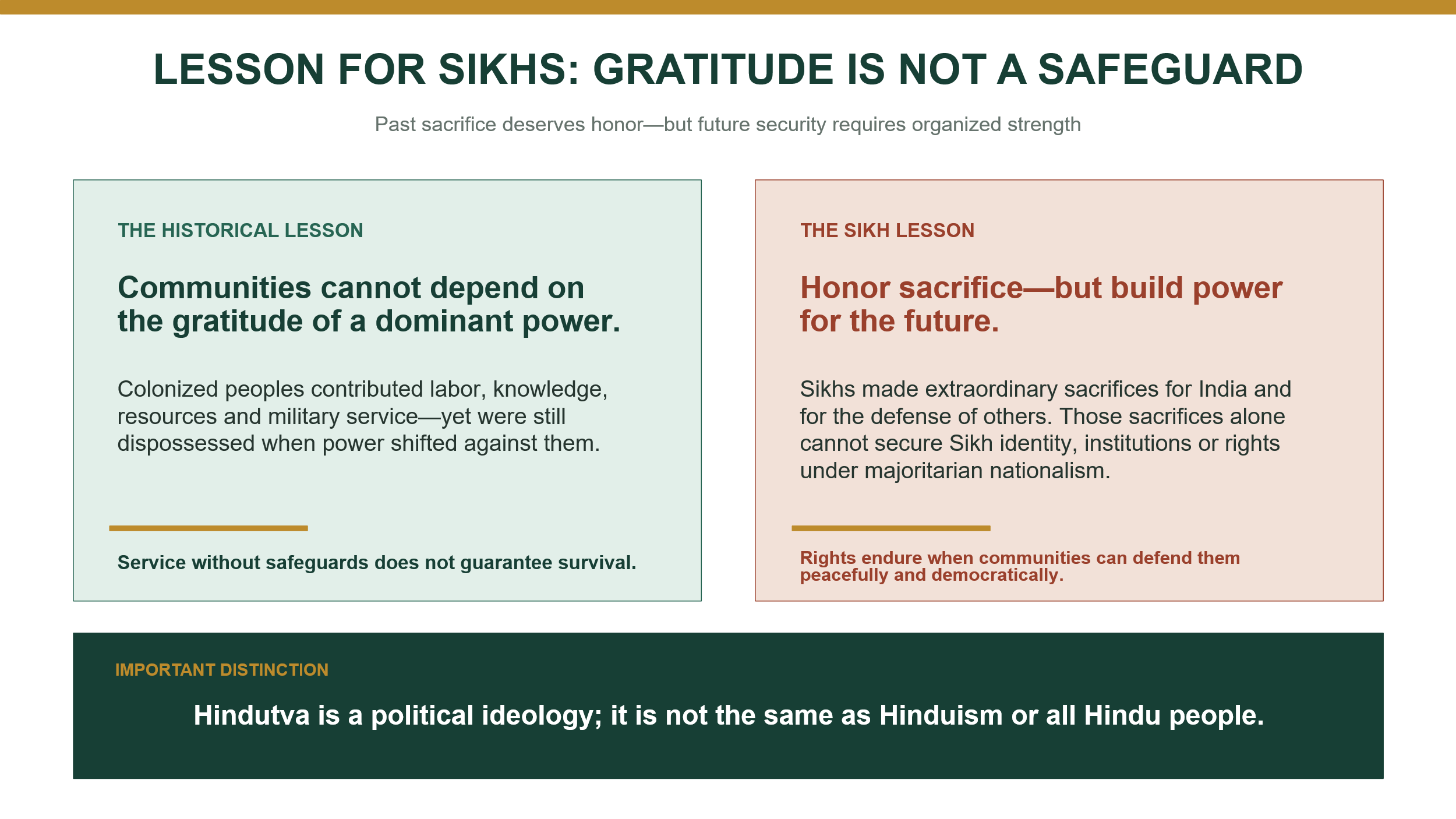
The appropriate lesson for Sikhs is not hostility toward Hindus, Christians, Muslims, or any other religious community.
Nor should historical suffering become justification for reciprocal majoritarianism.
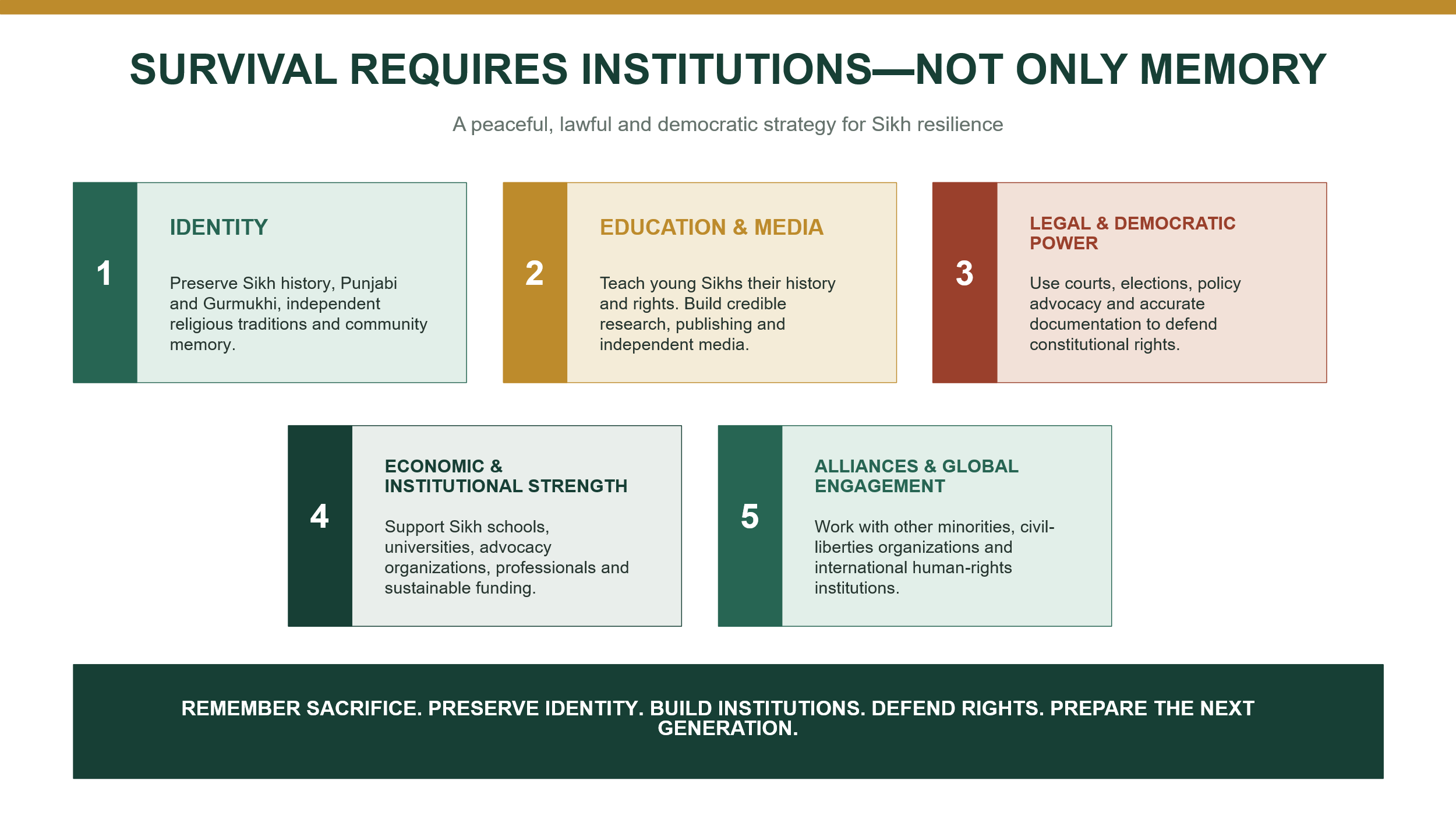
The lesson is the importance of institutional survival.
A minority community preserves itself through education, historical literacy, independent scholarship, economic strength, democratic participation, preservation of language, strong institutions, documentation of human rights violations, international engagement, and the transmission of its intellectual and religious heritage to succeeding generations.
The Haudenosaunee survived enormous colonial pressures partly because collective memory, political traditions, ceremonies, community structures, and records such as wampum belts helped preserve identity across generations.
Sikhs similarly possess exceptionally powerful institutions of collective memory: Sri Guru Granth Sahib, Gurdwara, Sangat, Pangat, Khalsa tradition, Punjabi and Gurmukhi, historical literature, and traditions of Miri-Piri and collective deliberation.
Preserving these institutions is not a form of separatism from humanity. Cultural and religious pluralism depends precisely upon communities having the freedom to remain themselves while participating as equal citizens in a larger political society.
Conclusion
The history of Indigenous America should not be mechanically superimposed upon twenty-first-century India. European settler colonialism involved territorial conquest, massive demographic collapse, displacement, warfare, epidemics, and in some circumstances explicit programs of cultural eradication. Contemporary India represents a fundamentally different historical and constitutional setting.
Yet history need not repeat itself identically for its warnings to matter.
The deeper parallel lies in a political idea: that national unity requires cultural uniformity and that minorities must ultimately conform to the majority’s civilization.
The tragedy of Indigenous America demonstrates where such thinking can lead when combined with overwhelming political power.
For India, the democratic alternative is not a Hindu India, Sikh India, Muslim India, or Christian India in which one community determines the legitimacy of everyone else. It is a constitutional society in which the numerical majority does not possess a greater right to the nation than the numerical minority.
And for Sikhs, the lesson of history should be neither fear nor hatred. It should be vigilance, education, institutional independence, democratic organization, historical memory, and the preservation of the community’s capacity to define itself.
History teaches that people need not be physically destroyed to disappear. A community can survive in numbers and yet lose itself when others acquire the power to rewrite its history, educate its children, redefine its faith, weaken its institutions, and persuade future generations that their distinct identity no longer matters. The most enduring defense against such erasure is not hatred of another people, but knowledge of one’s own history, confidence in one’s identity, strong independent institutions, and the courage to preserve them. People survive not merely by remaining alive, but by retaining the power to remember who they are and to determine who they will become.