The Haudenosaunee Confederacy and the Federal Structure of the United States: Benjamin Franklin, the Iroquois League, and the Origins of American Union
Dr. Gurinder Singh Grewal
August 22, 2026
Introduction
The creation of the United States Constitution in 1787 did not occur in an intellectual vacuum. The framers drew upon numerous political traditions: English constitutionalism, classical Greek and Roman political thought, Enlightenment philosophers such as John Locke and Montesquieu, the experience of colonial governments, and the failures of the Articles of Confederation. Yet another political system existed immediately before the colonists’ eyes: the Haudenosaunee Confederacy, historically called the Iroquois League.
Long before the establishment of the United States, the Mohawk, Oneida, Onondaga, Cayuga, and Seneca nations had formed a political confederation under the Great Law of Peace; the Tuscarora later joined, creating the Six Nations. Each nation maintained substantial authority over its own internal affairs while participating in a common council responsible for matters affecting the confederacy as a whole.
This arrangement presents an important conceptual parallel with American federalism: political communities could preserve their separate identities and governments while simultaneously belonging to a larger political union.
The historical evidence is particularly important because Benjamin Franklin knew the Haudenosaunee political system well before the Constitutional Convention. Franklin explicitly referred to the Six Nations as evidence that separate political communities could successfully establish a durable union. More than three decades before the Constitution was written, he advocated a comparable union among the British colonies.
It would nevertheless be historically excessive to claim that the United States Constitution was copied from the Great Law of Peace. The degree of Haudenosaunee influence remains the subject of substantial scholarly debate. The stronger and more defensible argument is that the Confederacy provided Franklin and other colonial leaders with a visible North American example of confederation, contributing to a broader intellectual development that eventually produced American federalism.
- The Haudenosaunee Political Achievement
The Haudenosaunee Confederacy originally united five distinct nations:
- Mohawk
- Oneida
- Onondaga
- Cayuga
- Seneca
The Tuscarora joined during the eighteenth century, producing what became commonly known as the Six Nations.
The political significance of the Confederacy was not that these peoples surrendered their identities and became one centralized nation. Rather, they created an overarching political structure while maintaining the integrity of the constituent nations.
The system was governed according to the Great Law of Peace, preserved through oral tradition and wampum. Representatives of the nations assembled in a Grand Council to deliberate upon matters of common concern. Consensus occupied an important place in decision-making. Clan mothers also exercised significant authority in selecting and, when necessary, removing leaders.
This created a sophisticated form of multilayered government:
Nation → Confederacy
The later American constitutional system would create:
State → Federal Union
The two systems were certainly not identical. Nevertheless, both confronted essentially the same political problem: How can several self-governing political communities cooperate under a common government without completely surrendering their separate political existence?
That is the fundamental problem of federalism.
- Unity Without Complete Centralization
The great political innovation represented by the Haudenosaunee system was the combination of unity and autonomy.
The individual nations continued to conduct much of their own internal governance. At the same time, the Confederacy provided an institutional mechanism for dealing with matters affecting the nations collectively.
This principle can be summarized as:
Local autonomy for local matters; collective authority for common matters.
The American federal system eventually adopted a related principle. States retained governments, legislatures, courts, and substantial governing authority, while the Constitution transferred specified national responsibilities to the federal government.
Thus:
| Several distinct nations | Several states |
| Each nation retains internal authority | States retain substantial internal authority |
| Grand Council handles common concerns | Federal government handles national concerns |
| Nations participate in confederal governance | States participate in federal governance |
| Union provides collective strength | Union provides collective defense and national power |
| Confederacy does not eliminate constituent nations | Constitution does not eliminate states |
The similarities should not be treated as proof of direct institutional copying. They are important because colonial leaders encountered a functioning Indigenous political union that demonstrated that plural political communities could remain distinct while governing certain affairs collectively.
III. Benjamin Franklin’s Knowledge of the Iroquois Confederacy
Benjamin Franklin provides the strongest documentary evidence of a connection between Haudenosaunee political organization and colonial thinking about union.
Franklin was not merely vaguely aware of the Six Nations. He dealt with Indigenous affairs, studied colonial-Indian relations, participated in diplomacy, and understood the political importance of the Haudenosaunee Confederacy.
The crucial evidence appears in Franklin’s March 20, 1751 letter to James Parker.
Discussing the difficulty of persuading the British colonies to unite, Franklin pointed directly to the Six Nations. He observed that it would be extraordinary if the Six Nations could maintain such a durable union while the English colonies were incapable of doing something similar.
This document is extraordinarily important.
It was written 36 years before the Constitutional Convention.
Franklin was therefore thinking about the problem of American political union decades before 1787, and, in doing so, he explicitly used the Haudenosaunee Confederacy as evidence that political union among separate communities was practical.
This establishes something stronger than a speculative similarity between the two political systems. It establishes a documented intellectual connection:
Haudenosaunee Confederacy → Franklin’s thinking about colonial union.
What remains debated is how far that influence subsequently extended into the particular institutions of the Constitution.
- From the Six Nations to Franklin’s Albany Plan
Franklin’s ideas became considerably more concrete in 1754, when representatives of several British colonies gathered at the Albany Congress.
The location and context are significant. Relations with the Haudenosaunee were an important concern of the meeting, and Haudenosaunee representatives participated in the wider diplomatic proceedings surrounding the Congress.
Franklin proposed what became known as the Albany Plan of Union.
The plan proposed a general government for the colonies consisting of a President-General and a Grand Council representing the colonies. The Grand Council would deal with matters of common importance, including defense and Indigenous affairs.
The Library of Congress describes Franklin as among the first Americans to envision a national confederation. It identifies the Albany Plan as an important predecessor to his later Plan of Confederation of 1775.
The intellectual progression is therefore striking:
Haudenosaunee Confederacy
↓
Franklin observes a successful union of separate nations.
↓
Franklin’s 1751 argument for colonial union
↓
Albany Plan of Union, 1754
↓
Revolutionary plans for colonial union
↓
Articles of Confederation, 1777
↓
Constitutional Convention, 1787
↓
Federal Constitution
This should not be interpreted as a simple line of copying. Political ideas developed through many sources and historical experiences. But Franklin represents an important intellectual bridge between the Indigenous example of confederation and the developing American search for political union.
- Franklin’s Albany Plan as a Precursor to American Federalism
The Albany Plan contained several concepts that later became fundamental to American constitutional government.
Franklin proposed that the colonies retain their existing governments while participating in a general government responsible for common concerns.
The Library of Congress records that the proposed Grand Council would be chosen through the colonial assemblies and that representation would be apportioned among the colonies according to specified criteria.
This was neither a completely centralized state nor merely an informal alliance.
It represented an intermediate concept:
separate governments + common government = political union
That formula lies at the heart of federalism.
Franklin’s plan failed politically. The colonies and British authorities rejected it for different reasons. Yet the underlying problem did not disappear: the colonies needed collective action but resisted surrendering local political authority.
That problem became even more important during the American Revolution.
- The Articles of Confederation: The First American Experiment
After declaring independence, the former colonies became states and established the Articles of Confederation.
The Articles created a union, but the central government remained weak. Congress lacked an independent executive, possessed inadequate taxing authority, and depended heavily upon state cooperation. The Library of Congress notes that these weaknesses eventually contributed to the decision to replace the Articles with a stronger constitutional arrangement.
The central constitutional question therefore remained:
How could the Americans preserve the states while simultaneously creating an effective national government?
The answer developed at Philadelphia in 1787 was federalism.
The states would neither remain entirely sovereign confederated republics nor disappear into a single centralized national government.
Instead, sovereignty and governing authority would be constitutionally distributed between two levels of government.
VII. Benjamin Franklin at the Constitutional Convention
Franklin’s role in this story continued directly into the Constitutional Convention.
In 1787, Benjamin Franklin served as a Pennsylvania delegate to the Philadelphia Convention. At eighty-one, he was the oldest delegate and one of the most respected political figures in America.
It is therefore important to state the historical claim precisely.
Franklin did not write the Constitution by himself, nor was he its principal architect. James Madison, James Wilson, Gouverneur Morris, Roger Sherman, George Washington, and many others made indispensable contributions.
But Franklin did participate directly in the Constitutional Convention that produced the Constitution.
More importantly, Franklin brought to Philadelphia more than thirty years of thinking about political union—thinking that demonstrably included his knowledge of the Six Nations.
Franklin also played a valuable role as a conciliator. During the bitter dispute between large and small states over representation, he participated in efforts at compromise. The eventual constitutional settlement created proportional representation in the House and equal representation of states in the Senate. The Senate Historical Office notes Franklin’s participation in the compromise process, including his proposal concerning revenue bills.
At the conclusion of the Convention, Franklin urged delegates to accept and sign the Constitution despite their individual objections.
Thus, the same Benjamin Franklin who in 1751 had pointed to the Six Nations as proof that political union was possible was present in 1787 when the American states finally established their durable federal union.
VIII. The Fundamental Parallel: A Union of Political Communities
Perhaps the most important possible Haudenosaunee contribution was not a particular constitutional clause but a political concept:
A union does not necessarily require the destruction of its constituent peoples or governments.
This principle distinguished federalism from a completely unitary state.
Under the Haudenosaunee system:
Mohawk remained Mohawk.
Seneca remained Seneca.
Oneida remained Oneida.
Yet they were simultaneously members of a larger Confederacy.
Under the American constitutional system:
Virginia remained Virginia.
Pennsylvania remained Pennsylvania.
New York remained New York.
Yet each became part of the United States.
The comparison therefore concerns the architecture of union itself:
Diversity + Autonomy + Shared Government = Federal Union
This was an enormously important political idea in a continent containing distinct political communities.
- The Great Law of Peace and Consensus
There were also important differences.
Haudenosaunee governance placed considerable emphasis on consensus. American constitutional government increasingly relied upon voting and majority decision-making, although constitutional restraints, bicameralism, federalism, judicial review, and supermajority requirements limited pure majority rule.
This distinction is important because it demonstrates why the U.S. Constitution cannot simply be described as a translation of the Great Law of Peace.
The Haudenosaunee system emerged from its own Indigenous political, cultural, spiritual, kinship, and diplomatic traditions.
The American Constitution emerged from a different political world involving English law, colonial institutions, republican political theory, Enlightenment philosophy, revolution, and the practical failures of the Articles of Confederation.
Influence therefore does not mean identity.
- The Important Role of Women
Another major difference concerns women.
Haudenosaunee women, particularly clan mothers, possessed political authority that had no equivalent in the original United States Constitution. Clan mothers participated in the selection of leaders and could remove chiefs who failed in their responsibilities.
American women, by contrast, did not receive a constitutional guarantee of voting rights until the Nineteenth Amendment was ratified in 1920.
Consequently, in certain respects the Haudenosaunee political tradition contained forms of female political authority that eighteenth-century American constitutional government did not adopt.
This is another reason that simplistic claims of direct copying should be avoided.
- The Scholarly Debate Over the “Iroquois Influence Thesis”
The extent of Haudenosaunee influence upon the United States Constitution has generated a significant historiographical debate.
Scholars such as Bruce E. Johansen and Donald A. Grinde Jr. have argued strongly for substantial Indigenous influence upon the development of American democratic and federal ideas.
Other scholars, notably Elisabeth Tooker, have challenged claims of direct institutional borrowing and questioned whether sufficient documentary evidence exists to demonstrate that specific provisions of the Constitution originated in the Great Law of Peace.
The William and Mary Quarterly devoted a scholarly forum to the controversy, including arguments both supporting and criticizing the “Iroquois Influence” thesis. Modern scholarship therefore does not support presenting the matter as an uncontested historical fact.
An academically responsible conclusion should distinguish three propositions.
First, Franklin knew about the Haudenosaunee Confederacy.
This is established.
Second, Franklin explicitly cited the Six Nations while arguing that the colonies themselves should unite.
This is also established by his 1751 correspondence.
Third, particular clauses of the 1787 Constitution were directly copied from the Great Law of Peace.
This is much harder to establish and remains disputed.
That distinction strengthens rather than weakens the historical argument.
XII. Congressional Recognition of Haudenosaunee Influence
The influence thesis eventually received formal political recognition in the United States.
In the late 1980s, Congress acknowledged the contribution of the Haudenosaunee Confederacy to the development of American constitutional government. A Library of Congress discussion notes the 1987 Senate recognition of the Six Nations’ influence and specifically identifies George Washington and Benjamin Franklin among founders familiar with and admiring aspects of Haudenosaunee governance.
Such congressional recognition is historically significant, but it should not be confused with scholarly proof. Congress can recognize a historical contribution; historians must still examine the documentary evidence and debate the precise nature and extent of influence.
XIII. Franklin as the Critical Historical Link
Benjamin Franklin is therefore central to understanding the relationship.
His political development provides a remarkable chronology:
1751 — Franklin explicitly points to the Six Nations as an example of successful political union.
1754 — Franklin develops the Albany Plan of Union.
1775 — Franklin proposes another plan of confederation as the colonies move toward independence.
1787 — Franklin participates in the Constitutional Convention.
This continuity matters.
Franklin did not suddenly discover federalism in Philadelphia in 1787. He had spent decades considering how separate American political communities could create a common government.
And at an early and formative stage of that intellectual development, he explicitly looked toward the Haudenosaunee Confederacy.
The Library of Congress itself notes that Franklin was intrigued by the way the Great Law balanced political interests and that he saw the Haudenosaunee example as relevant to the problem of colonial union.
XIV. Multiple Roots of American Federalism
American federalism is best understood as having multiple intellectual and historical roots, rather than a single origin.
These included:
European political thought
- English constitutional traditions
- John Locke
- Montesquieu
- Classical republicanism
American colonial experience
- Colonial assemblies
- Intercolonial congresses
- Revolutionary government
- State constitutions
Practical political experience
- Failures of the Articles of Confederation
- Interstate economic disputes
- Need for taxation and defense
- Need for national foreign policy.
Indigenous political experience
- The visible and durable example of the Haudenosaunee Confederacy
- Diplomatic interaction between colonial leaders and the Six Nations
- Franklin’s explicit comparison between Haudenosaunee union and his desired colonial union
Understanding all these sources provides a more complete history of American constitutionalism than attributing the Constitution exclusively to European political philosophy.
- A North American Dimension of American Constitutional History
For generations, accounts of the Constitution concentrated overwhelmingly on European intellectual antecedents.
Those influences were unquestionably profound. But an exclusively European explanation overlooks an obvious historical reality: colonial Americans were living in North America, surrounded by Indigenous political societies with which they negotiated, traded, fought, formed alliances, and exchanged political information.
The Haudenosaunee Confederacy was not a theoretical political system contained in a European philosophical book.
It was a functioning political union.
Franklin and other colonial officials encountered representatives of that union directly. Franklin’s surviving writing proves that he considered its durability relevant to the political problem confronting the colonies.
Thus, even if historians continue to disagree about whether individual constitutional provisions can be traced directly to the Great Law of Peace, the Haudenosaunee example deserves a place within the intellectual environment in which American ideas about union developed.
Conclusion
The most defensible historical conclusion is neither that the United States Constitution was copied from the Iroquois Confederacy nor that the Confederacy had no relevance to American constitutional development. One important clarification for academic credibility is that while Benjamin Franklin was indeed a delegate to the 1787 Constitutional Convention and played a pivotal role in its acceptance, he was not the sole or principal drafter of the Constitution.
The historical relationship is subtler and more important.
The Haudenosaunee Confederacy demonstrated, on the North American continent, that distinct political communities could maintain their own identities and internal authority while joining together under a durable common political structure.
Benjamin Franklin understood this achievement.
As early as 1751, Franklin explicitly invoked the Six Nations when arguing that the British colonies should be capable of creating a similar union. Three years later, he presented the Albany Plan, one of the earliest serious proposals for an intercolonial general government. More than three decades later, Franklin served as a delegate to the Constitutional Convention, helping secure the Constitution’s compromise and acceptance, though not as its principal author.
The intellectual relationship can therefore be represented cautiously as:
Great Law of Peace and Haudenosaunee Confederacy
↓
A functioning North American model of union with constituent autonomy
↓
Benjamin Franklin’s documented admiration for the Six Nations’ capacity for union
↓
Albany Plan of Union (1754)
↓
Continuing American experiments with confederation
↓
Articles of Confederation
↓
Constitutional Convention (1787)
↓
United States federal system
The arrows should be understood as historical connections and development, not proof of direct copying at every stage.
That distinction is essential academically. It allows recognition of the Indigenous contribution without overstating the evidence.
The deeper historical lesson is that American federalism emerged from a plural intellectual world. European political philosophy was important, but so were the political experiences of the peoples already governing themselves in North America. Among those peoples, the Haudenosaunee created one of the continent’s most remarkable systems of political union. The strongest argument is that Franklin forms a documented bridge among knowledge of the Haudenosaunee confederation, his 1754 Albany Plan, and his later participation in the creation of the federal constitutional order. Franklin knew of that achievement, explicitly reflected upon it, and spent much of his political career attempting to solve a remarkably similar problem: how to transform separate political communities into a durable union without extinguishing their individual identities.
That idea became one of the defining principles of the American constitutional system.
The Haudenosaunee (Iroquois) Confederacy demonstrated a sophisticated system of federal union and representative decision-making that influenced—or at least closely paralleled—important features of American federalism.
European colonization of the Americas brought one of the greatest demographic catastrophes in human history. In many Indigenous regions, populations declined by an estimated 75 to 95 percent, although the precise numbers remain disputed. Epidemics such as smallpox, measles, and influenza were the largest immediate cause of death, but disease cannot be separated from the colonial system that intensified its effects
Actions of the colonial powers
- Spain: Conquered the Caribbean, Mexico, Central America, and much of South America. Spanish forces committed massacres and imposed the encomienda and forced-labor systems. Disease, starvation, warfare, mining, and plantation labor devastated the Taíno, Aztec, Inca, and many other peoples.
- Portugal: Colonized Brazil. Portuguese settlers seized Indigenous lands, conducted slave-raiding expeditions, forced people to work on plantations, destroyed villages, and spread diseases. Many communities fled into the interior or were killed resisting occupation.
- England/Britain: Established settler colonies along the Atlantic coast and in the Caribbean. Colonists took land for permanent settlement, fought wars against Native nations, destroyed villages and food supplies, and later imposed forced removal and reservation policies.
- France: Colonized parts of Canada, the Great Lakes, the Mississippi Valley, and the Caribbean. Although French settlement was generally smaller, colonization still spread epidemics, intensified warfare, imposed missions and trade dependency, claimed Indigenous lands, and displaced communities.
- The Netherlands: Controlled New Netherland, parts of Brazil, Guyana, Suriname, and Caribbean islands. Dutch colonists seized land, used enslaved labor, attacked Native communities, destroyed villages, and expanded plantation systems.
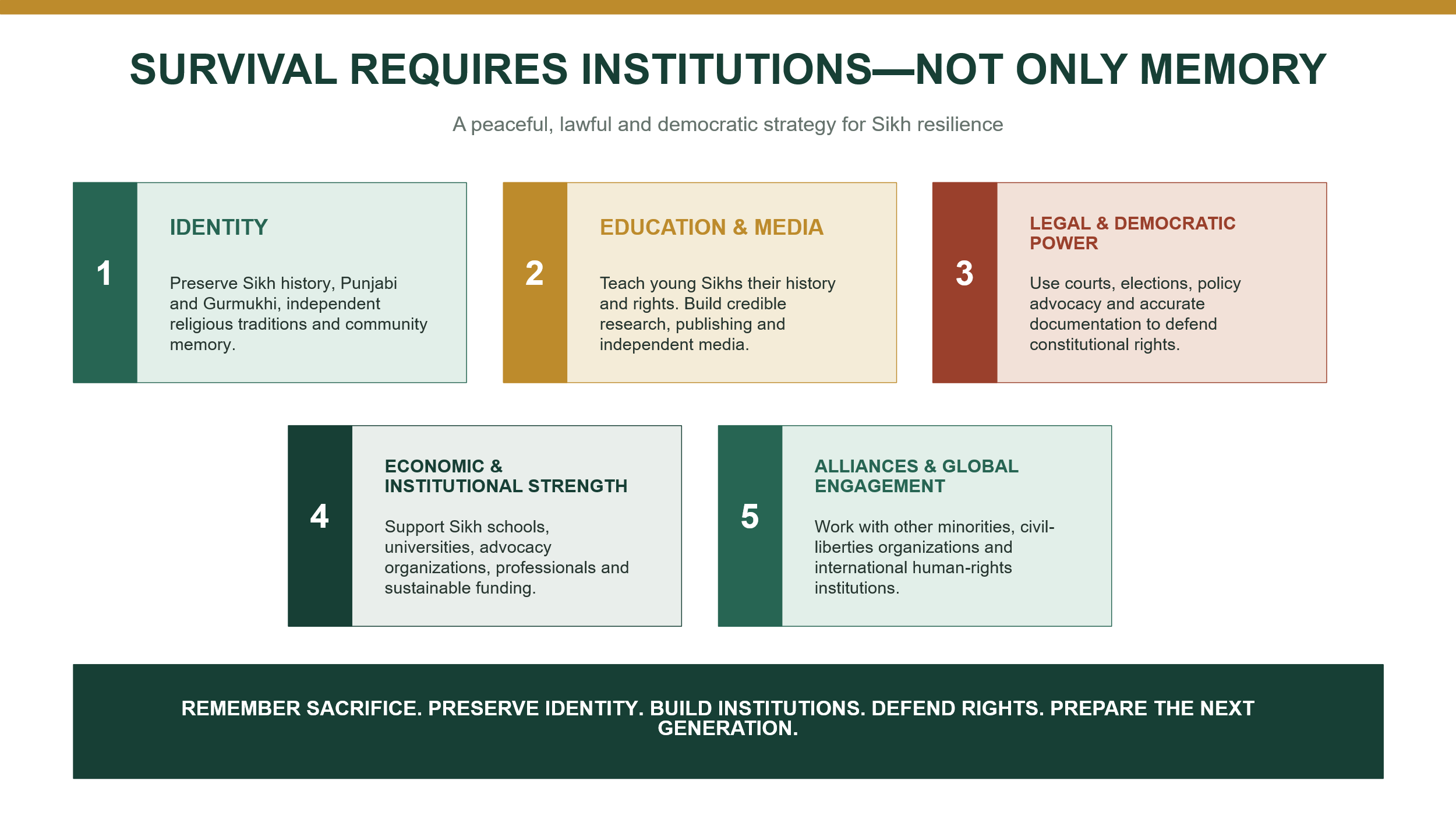
Lesson for Sikhs: Survival Requires Institutions, Not Gratitude
Sikhs made enormous sacrifices for the freedom, protection, and welfare of India and its people. However, past service does not guarantee future security under any majoritarian political system.
The lesson of colonization is not to remain trapped in memories of sacrifice or expect permanent gratitude. Communities survive by building lasting strength:
- Preserve Sikh identity, history, language, and independent institutions.
- Educate young Sikhs about their constitutional and human rights.
- Document discrimination, political violence, and historical injustice.
- Build economic strength, professional leadership, and independent media.
- Participate in democratic and legal advocacy in India and internationally.
- Form alliances with other minorities and defenders of human rights.
- Resist injustice through peaceful, lawful, and democratic action.
Hindutva is a political ideology and should not be confused with all Hindus. The concern is majoritarian nationalism that attempts to subordinate religious minorities and absorb their distinct identities.
Concluding statement:
“Honor Sikh sacrifices—but do not depend upon gratitude. Preserve identity, strengthen institutions, defend rights, and prepare future generations to survive every form of majoritarian domination.”