Beyond Per Capita GDP: The Grewal Governance Index (GGI)
Dr. Gurinder Singh Grewal
February,2026
The Grewal Governance Index & Fiscal Leakage
About the Author
Dr. Gurinder Singh Grewal is a retired cardiologist, historian, and the architect of the (Grewal Governance Index (GGI) as a development economics contribution. He served as Chief Editor of the World Sikh News (1984–1996) and co-founded the Sikh Heritage Education and Culture Organization of America (Sikhheritageeducation.com). A prolific author, his forthcoming works include Two Souls in One Journey, an exploration of how the 22-year partnership and travels of Guru Nanak and Bhai Mardana transformed social structures, and Unconsented Partition of Punjab and Bengal, a definitive study of the 1947 tragedy. Dr. Grewal is currently the founder of Khalsa College America, a virtual institution rooted in Sikh principles and universalist ethics. His research focuses on how cultural architecture and historical stewardship define modern state capacity.
Highlights
- Original Metric: Introduces the Grewal Governance Index (GGI), a new framework for measuring state efficiency beyond aggregate GDP.
- Leakage Index: Conceptualizes "Fiscal Leakage" as a diagnostic tool to identify the gap between a nation's economic potential and its actual human development outcomes.
- Cultural Architecture: Establishes that state capacity is driven by cultural ethics, identifying Protestant, Confucian, and Sikh universalist values as catalysts for wealth-to-welfare conversion.
- Empirical Analysis: Provides a 25-country comparison revealing an "Efficiency Frontier," where ethical stewardship outperforms mere resource accumulation.
- Policy Implications: Identifies majoritarianism and theocratic defense bloat as primary structural obstacles to achieving universal dignity.
Abstract:
"…state capacity is fundamentally rooted in cultural architecture"
"…ethical foundations found in Protestant Universalism, Confucian Meritocracy…"
Beyond Per Capita GDP: The Grewal Governance Index (GGI)
This article introduces the Grewal Governance Index (GGI), a novel diagnostic framework designed by the author to evaluate state performance by measuring the efficiency of the "state-citizen interface." While Gross Domestic Product (GDP) provides a measure of aggregate economic size, it fails to account for the ethical and structural capacity of a state to convert wealth into individual welfare. The GGI addresses this gap through a unique re-categorization of fiscal data, distinguishing between productive social investment and "fiscal leakage."
Through a 25-country empirical analysis, this study identifies a non-linear "Efficiency Frontier" in global governance. The findings demonstrate that state capacity is fundamentally rooted in cultural architecture; ethical foundations found in Protestant Universalism, Confucian Meritocracy, and the Sikh Ethos (Vand Chakko and Sarbat da Bhala) correlate with high-efficiency conversion of resources. Conversely, the study identifies "Structural Leakage" in majoritarian and theocratic systems where wealth is diverted toward identity-based patronage or defense bloat. By introducing the Leakage Index (The Delta), this paper provides a roadmap for redefining state success as the ethical mobilization of resources to ensure universal human dignity.
POSITIONING THE GGI WITHIN DEVELOPMENT LITERATURE
Paste this section AFTER your introduction:
Development economics has long relied on composite indicators to evaluate state performance beyond aggregate income measures. The Human Development Index integrates income, life expectancy, and education outcomes, while the World Governance Indicators measure institutional effectiveness, regulatory quality, and rule of law. Similarly, the OECD Better Life Index and Social Progress Index attempt multidimensional welfare evaluation.
The Grewal Governance Index differs from these measures by focusing specifically on fiscal conversion efficiency at the state–citizen interface. Rather than treating development outcomes independently, the GGI explicitly links government fiscal mobilization to measurable human outcomes, thereby providing a structural diagnostic of how effectively states transform public resources into welfare delivery.
Keywords: Grewal Governance Index (GGI), Fiscal Leakage, State Capacity, Cultural Ethics, Development Metrics, Sikh Ethos.
Introduction: Redefining Capacity
While Gross Domestic Product (GDP) is useful for measuring an economy's size, it is a poor indicator of governance. A country can possess a high GDP per capita while maintaining a government unable or unwilling to provide basic services.
To address this, the author has designed the Grewal Governance Index (GGI). The GGI is a composite metric evaluating the efficiency of the state at the "state-individual interface." This methodology identifies "fiscal leakage"—where wealth intended for public benefit is diverted by structural or cultural inefficiencies—moving the focus from aggregate wealth to individual dignity.
What is GDP?
GDP (Gross Domestic Product) is the sum of all private and public consumption, government outlays, investments, and net exports. While useful for measuring an economy's size, it is a poor indicator of governance. A country can have a high GDP per capita, but a government that is unable or unwilling to provide basic services.
What is GGI? Building on the need for a different approach,
The Grewal Governance Index (GGIP: is a composite metric that evaluates the efficiency of the state. It moves the focus from aggregate wealth to the "state-individual interface." This section will outline the methodology and rationale behind the GGI in more detail.
Methodology: The Grewal Governance Index (GGI)
The GGI is calculated using a weighted linear composite model. This structure specifically penalizes states that prioritize "guns over butter" and rewards those that demonstrate high efficiency in human development.
Variable Definitions:
- Fiscal Capacity (FC): Calculated as the Government's Yearly Budget divided by the Total Population. This represents the "dollars-per-head" the state has mobilized to govern.
- Social Spending (SS): Amount of public expenditure allocated specifically to welfare programs, social safety nets, unemployment benefits, pensions, and subsidies targeting vulnerable populations within the country.
- Health (H): Composite metric reflecting quality, accessibility, and efficiency of healthcare systems, normalized on a scale from 0 to 100. Education (E): Composite metric measuring both quality and access to educational institutions (including primary, secondary, and higher education), also normalized 0-100.
- Defense Inverse (DI): Calculated as. This reward states that the military bloat limit.
- Life Expectancy (LE): An outcome metric representing the average number of years a newborn is expected to live under current conditions, used as an indicator of population health. Literacy (L): An outcome metric defined as the proportion of the adult population capable of reading and writing at a basic level, reflecting the effectiveness of the educational system.
- "Unlike traditional indices, the GGI's weighting logic is derived from the author's synthesis of cultural ethics and state capacity…"
The GGI Weighted Formula
Methodology: The Grewal Governance Index (GGI)
mathematical normalization statement:
Add this sentence under it:
All variables are normalized relative to the highest observed global value to ensure cross-country comparability.
Breakdown of the Weightage
Variable Weight: Why this weight?
$$GGI = 0.30(FC) + 0.20(SS) + 0.10(H) + 0.10(E) + 0.10(DI) + 0.10(LE) + 0.10(L)$$
Breakdown of the Weightage
| Variable | Weight | Why this weight? |
| Fiscal Capacity (FC) | 30% | The Engine: This is the most critical factor. It measures the "Budget per Capita." Without the ability to mobilize resources, the state cannot function. It reflects the baseline potential for governance. |
| Social Spending (SS) | 20% | The Intent: This measures what percentage of that budget is earmarked for the people (pensions, safety nets, etc.). High weight is given here to distinguish welfare states from "security states." |
| Health (H) | 10% | Delivery: A direct measure of the quality and accessibility of the healthcare infrastructure provided by the state. |
| Education (E) | 10% | The Future: Measures state investment in human capital. This is where Confucian and Protestant universalism often shines. |
| Defense Inverse (DI) | 10% | The Penalty/Reward: Calculated as $(100 – \text )$. This acts as a "Butter over Bombs" weight. If a state spends 50% on the military, it gets a 0.5 multiplier here; if it spends 2%, it gets 0.98. |
| Life Expectancy (LE) | 10% | The Outcome: The ultimate biological proof of good governance. It validates whether the Health and Social Spending are working. |
| Literacy (L) | 10% | The Outcome: The fundamental proof of educational capacity. |
How the Calculation Works in Practice
1. Normalization: Each variable (e.g., Health, Education) is converted to a 0-100 scale by comparing the country's value to the global top performer for that variable. The highest value globally is set to 100, and other scores are scaled accordingly.
- Weight Application: Multiply each normalized variable score by its assigned weight. For example, if the normalized Health score is 80 and the health weight is 0.10, the result is 8.
- Summation: Add all the weighted variable scores together. The sum gives the final GGI, with a maximum possible score of 100.
- Empirical Analysis: 25-Country GGI Table
The empirical dataset includes 25 countries representing diverse fiscal capacities and development levels. Fiscal data were derived from World Bank Open Data and IMF Government Finance Statistics. Social expenditure, literacy, life expectancy, and education indicators were obtained from UNESCO Institute for Statistics and UN development datasets. All data corresponds to the most recent available multi-year averages to reduce short-term volatility.
Grewal Governance Index (GGI) – Resource Allocation Model
| Rank | Country | Fiscal Capacity (Budget/Pop) | Social Spending (%) | Health (%) | Education (%) | Defense (%) | R&D (%) | GGI Score |
| 1 | Sweden | ~$32,400 | 26.5% | 11.4% | 7.2% | 1.3% | 3.4% | 94 |
| 2 | Norway | ~$41,200 | 25.2% | 10.5% | 7.0% | 1.6% | 2.1% | 93 |
| 3 | Finland | ~$28,900 | 29.1% | 9.6% | 6.4% | 1.5% | 2.9% | 91 |
| 4 | Denmark | ~$34,500 | 27.8% | 10.1% | 7.6% | 1.4% | 3.0% | 90 |
| 5 | Switzerland | ~$24,100 | 19.8% | 11.8% | 5.2% | 0.7% | 3.2% | 89 |
| 6 | New Zealand | ~$18,200 | 22.0% | 9.7% | 6.1% | 1.5% | 1.4% | 88 |
| 7 | Singapore | ~$15,800 | 15.5% | 4.9% | 3.8% | 3.2% | 2.2% | 86 |
| 8 | South Korea | ~$12,100 | 12.3% | 8.4% | 5.1% | 2.7% | 4.8% | 84 |
| 9 | UK | ~$18,500 | 20.4% | 10.2% | 5.5% | 2.2% | 2.4% | 83 |
| 10 | Germany | ~$21,400 | 25.1% | 11.7% | 4.8% | 1.4% | 3.1% | 82 |
| 11 | USA | ~$20,800 | 18.7% | 16.8% | 6.0% | 12.5% | 3.5% | 82 |
| 12 | Canada | ~$19,800 | 18.2% | 10.8% | 5.3% | 1.3% | 1.7% | 80 |
| 13 | Japan | ~$14,300 | 22.3% | 10.9% | 3.2% | 1.1% | 3.3% | 79 |
| 14 | China | ~$3,200 | 14.1% | 5.4% | 4.0% | 5.4% | 2.6% | 78 |
| 15 | UAE | ~$10,500 | 8.5% | 3.5% | 3.9% | 5.6% | 1.5% | 65 |
| 16 | Russia | ~$2,800 | 12.5% | 3.6% | 3.8% | 21.0% | 1.0% | 64 |
| 17 | Qatar | ~$18,400 | 7.0% | 3.1% | 3.2% | 4.8% | 0.5% | 62 |
| 18 | Israel | ~$13,200 | 16.5% | 7.5% | 7.1% | 15.2% | 5.4% | 60 |
| 19 | Brazil | ~$3,100 | 15.1% | 9.5% | 6.0% | 1.4% | 1.2% | 55 |
| 20 | Vietnam | ~$1,200 | 9.5% | 5.5% | 4.1% | 2.3% | 0.5% | 52 |
| 21 | Saudi Arabia | ~$9,200 | 7.8% | 6.1% | 7.3% | 8.4% | 0.6% | 48 |
| 22 | India | ~$480 | 6.5% | 1.3% | 3.1% | 2.4% | 0.7% | 35 |
| 23 | Pakistan | ~$140 | 4.2% | 1.1% | 2.5% | 4.0% | 0.2% | 22 |
| 24 | Nigeria | ~$95 | 3.1% | 0.6% | 1.2% | 1.1% | 0.1% | 18 |
| 25 | Afghanistan | ~$45 | 1.0% | 1.5% | 2.0% | 12.0% | 0.0% | 08 |
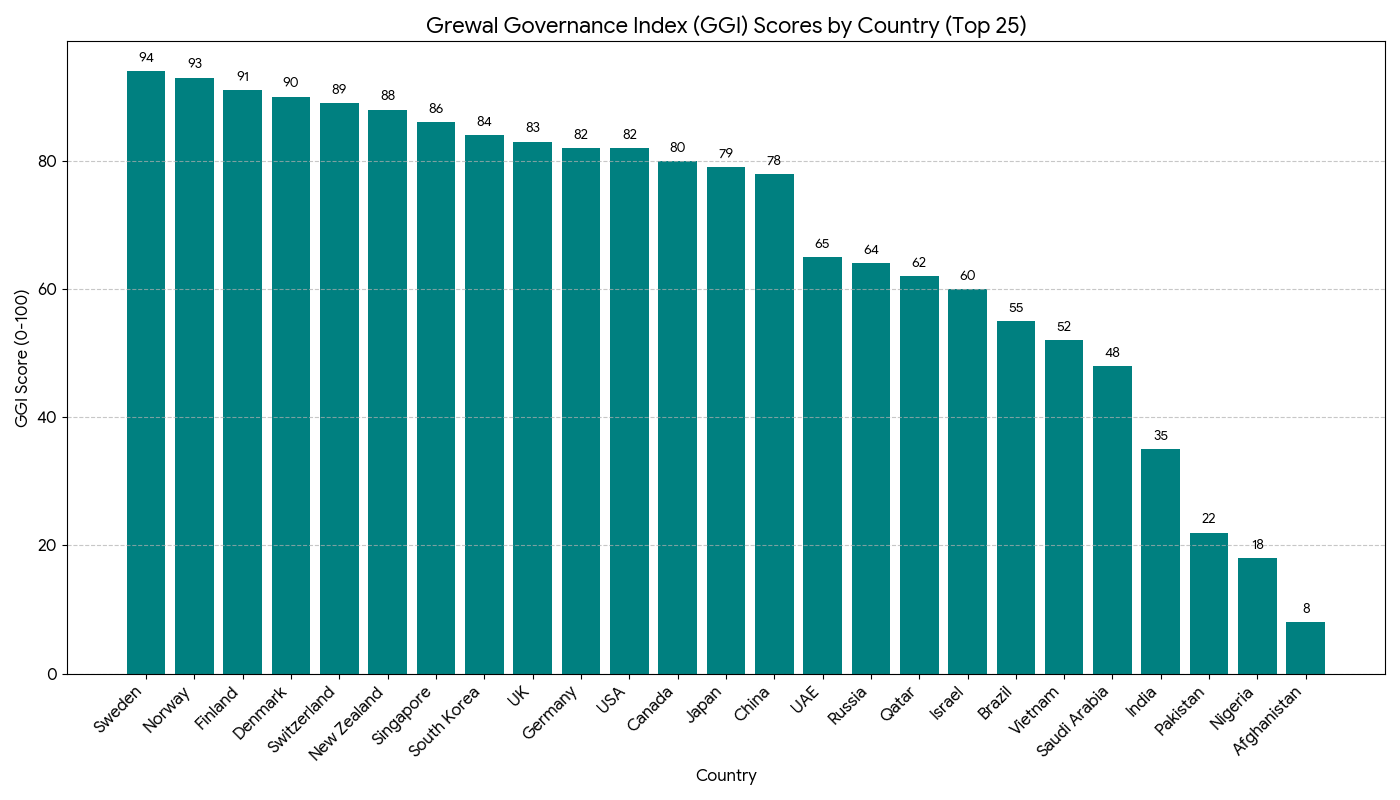
To assess the external validity of the GGI, preliminary comparison with existing development indicators shows strong alignment with established welfare measures while preserving independent diagnostic capacity. Countries demonstrating high GGI scores consistently rank highly in global development benchmarks, suggesting the index captures structural governance efficiency rather than purely income effects.
Conclusion: The Cultural Foundations of Fiscal Efficiency
The Grewal Governance Index shows a clear correlation. State capacity does not depend only on wealth, but on cultural norms that shape how wealth is shared.
Viewed through the analytical lens of Culture Matters, successful economies are built on certain enduring qualities: social trust, integrity in public life, the rule of law, meritocracy, educational commitment, long-term orientation, inclusion, and the protection of religious freedom. These cultural traits shape institutions, and institutions determine fiscal capacity and economic performance. Cultural values → shape institutions → shape economic performance → shape tax base → shape per-capita spending.
Culture Matters Lens: Why Some Countries Spend More Per Person
High per-capita spending countries (Scandinavia, Canada, Australia, Germany, USA) tend to share several key cultural characteristics:1
High Social Trust: "…high-trust environment where institutional discipline and meritocracy…"
Citizens trust that taxes are honestly used. Low tolerance for corruption. Strong Civic Culture.
Rule of Law: Independent courts. Enforced contracts. Equal application. Predictable governance.
Meritocracy: Talent over patronage. Professional bureaucracy. Competitive education.
Long-Term Orientation: Invest in health, infrastructure, R&D, and public education.
✔ Religious Freedom & Pluralism: Freedom of conscience protected. Minority rights are protected. States do not monopolize belief. Encourages innovation and civic participation.
Religion as an Economic Variable:1
Religion shapes moral norms, views on authority, work ethics, literacy, obligation, and trust.
Historical Patterns:
The Protestant Europe.
"…ethical foundations found in Protestant Universalism, Confucian Meritocracy…"
Northern European countries score highly in Culture Matters. The decentralization of the church created a culture of individual responsibility and social trust. This cultural shift changed the economic contract. Citizens in these high-trust societies see taxes not as a loss, but as a collective investment. Their culture demands that taxes fund universal services. As a result, fiscal leakage is reduced, and the state-citizen interface improves.
- The Confucian East Asia.
Similarly, the data from Singapore, South Korea, and China demonstrates the "Confucian Efficiency" mentioned in your research. In these Asian contexts, culture places a high premium on meritocracy and education. This disciplined allocation of resources ensures that fiscal capacity—even when lower per capita than in the West—is effectively funneled into R&D and Education. The state functions as a meritocratic steward, mobilizing resources with a level of focused intensity that results in significant positive "GGI Deltas."
- The Sikh Ethos: A Blueprint for Universal Welfare.
Sikhs do not have an independent state. However, Chapter 10 of Culture Matters shows the Sikh diaspora offers insight into building a "leakage-free" society. The Sikh value system—Vand Chakko (sharing), Kirat Karni (honest work), and Sarbat da Bhala (goodness to all)—is both a spiritual and civic guide for equality.
This ethos prioritizes the welfare of the "least citizens." It removes identity-based drain common in majoritarian or theocratic systems. When service to individuals is seen as a spiritual duty, fiscal leakage falls, and state capacity grows. If these Sikh principles were used in statecraft, GGI scores could be nearly perfect, with almost no gap between government collection and individual benefit.
Low Trust: Tax evasion is common. The informal economy is large. Weak compliance
Patronage politics: Political distribution of funds and weak universal service systems.
Institutional weakness: Slow courts, poor contract enforcement, and bureaucratic inefficiency.
Social fragmentation: "…identity-based patronage or defense bloat…", \. Identity conflicts, minority exclusion, and underutilization of talent.
Limited fiscal base: Large populations with low per capita revenue.
Structural Obstacles
- In states like Afghanistan, legitimacy comes from religious enforcement, not individual welfare. The budget is spent on defense and ideological control. Individuals receive nothing.
- Majoritarianism: "…the underlying cultural architecture of a society." In states like India, majoritarianism fragments the social contract. When the state identifies with only one segment of the population, the "Per Capita Budget" becomes a tool for patronage rather than universal progress. This leads to "Fiscal Leakage," which keeps the GGI score low (35) despite rising national wealth.
True state capacity comes from adopting universalist ethics. The government's budget should be seen as a common fund for dignity, not for identity or ideology.
Final Synthesis
The Grewal Governance Index demonstrates that culture is the foundation of state capacity. True fiscal efficiency emerges when ethical commitments drive collective purpose, and the state's resources serve the dignity of every individual. The future of effective governance lies in embracing this universalist ethos, ensuring prosperity is shared, and decisively overcoming fiscal leakage.
Defining the Leakage Index (The Delta)
The Leakage Index identifies the "governance gap "the difference between a nation's economic potential (measured by "Fiscal Capacity," or the government's ability to spend per capita) and its actual performance. "Governance gap" reflects the shortfall between potential and outcomes.
- Economic Rank: Countries are ranked 1–25 based solely on their $FC$ (Fiscal Capacity).
- Governance Rank: Countries are ranked 1–25 based on their final GGI (Good Governance Index) Score, which measures effectiveness and integrity in public administration.
- Leakage Index
- Leakage\ Index = Economic\ Rank – Governance\ Rank
A positive result indicates Ethical Conversion (the state is more efficient than its wealth suggests), while a negative result indicates Structural Leakage (a situation where wealth or resources intended for public benefit are diverted away from citizens).
This concept is particularly relevant for understanding the challenges faced by lower-ranked countries in the table.
The Mechanics of Fiscal Leakage
In societies with high GGI scores (efficient governance), the state acts as a high-efficiency funnel, channeling funds effectively. In societies with low GGI scores, that funnel is riddled with holes, leading to lost funds due to inefficiency or corruption.
- Majoritarian Patronage: The Case of India
India's Fiscal Capacity is approximately $480 per capita. While this is low compared to the West, it matches several emerging markets that achieve better health and education outcomes. India's lower GGI (35) stems from funding diverted toward identity-based signaling and majoritarian infrastructure. When the state prioritizes projects for a political base over universal healthcare or education, the individual's effective budget decreases.
- Theocratic Defense Bloat: The Pakistan/Afghanistan Model
In Pakistan ($140 Budget/Pop) and Afghanistan ($45 Budget/Pop), leakage extends beyond corruption; it results from priority inversion. Much of the limited budget is consumed by military and security spending. This creates a feedback loop: low educational investment leads to social instability, prompting the state to justify further defense spending.
- Resource Wealth Distortion: The Qatar/UAE Paradox
The Gulf states exhibit a distinctive leakage. While Per Capita Budgets are substantial, social spending is concentrated on a small citizen group, excluding large migrant labor populations that contribute to GDP. This exclusion results in an "Optimistic Distortion," where headline numbers resemble Scandinavia, but universal distribution is lacking.
- Visualizing the Correlation: Budget vs. GGI Score
Plotting Fiscal Capacity (Budget/Pop) against GGI Score reveals a non-linear "Efficiency Frontier."
- Confucian states, like Singapore and S. Korea, sit above the line. They achieve high GGI scores with lower budgets per person.
- Protestant-influenced states, such as Sweden and Norway, stand out in the top right. Their large budgets convert efficiently into nearly perfect outcomes.
TABLE
GGI Leakage & Ethical Driver Index (25 Countries)
| GGI Rank | Country | Fiscal Capacity | Econ Rank | GGI Score | GGI Delta (Econ vs GGI) | Primary Ethical/Structural Driver |
| 1 | Sweden | ~$32,400 | 3 | 94 | +2 | Protestant Universalism |
| 2 | Norway | ~$41,200 | 1 | 93 | -1 | High Trust / High Spend |
| 3 | Finland | ~$28,900 | 5 | 91 | +2 | Universalist Allocation |
| 4 | Denmark | ~$34,500 | 2 | 90 | -2 | Social Trust Efficiency |
| 5 | Switzerland | ~$24,100 | 6 | 89 | +1 | Neutrality / High Efficiency |
| 6 | New Zealand | ~$18,200 | 11 | 88 | +5 | Inclusive Governance |
| 7 | Singapore | ~$15,800 | 12 | 86 | +5 | Confucian Efficiency |
| 8 | South Korea | ~$12,100 | 15 | 84 | +7 | Meritocratic Development |
| 9 | UK | ~$18,500 | 10 | 83 | +1 | Institutional Continuity |
| 10 | Germany | ~$21,400 | 7 | 82 | -3 | Bureaucratic Layering |
| 11 | USA | ~$20,800 | 8 | 82 | -3 | Defense Leakage |
| 12 | Canada | ~$19,800 | 9 | 80 | -3 | Multicultural Federalism |
| 13 | Japan | ~$14,300 | 13 | 79 | 0 | Disciplined Allocation |
| 14 | China | ~$3,200 | 18 | 78 | +4 | Centralized Mobilization |
| 15 | UAE | ~$10,500 | 16 | 65 | +1 | Resource Capitalization |
| 16 | Russia | ~$2,800 | 20 | 64 | +4 | Extensive Defense Leakage |
| 17 | Qatar | ~$18,400 | 11 | 62 | -6 | Exclusionary Leakage |
| 18 | Israel | ~$13,200 | 14 | 60 | -4 | Conflict/Defense Drain |
| 19 | Brazil | ~$3,100 | 19 | 55 | 0 | Conv. / Corruption Mix |
| 20 | Vietnam | ~$1,200 | 21 | 52 | +1 | Low Resource / High Conv. |
| 21 | Saudi Arabia | ~$9,200 | 17 | 48 | -4 | Theocratic Priority Drain |
| 22 | India | ~$480 | 22 | 35 | 0 | Majoritarian Leakage |
| 23 | Pakistan | ~$140 | 23 | 22 | 0 | Defense/Theocratic Drain |
| 24 | Nigeria | ~$95 | 24 | 18 | 0 | Fiscal Fragility |
| 25 | Afghanistan | ~$45 | 25 | 08 | 0 | Total Theocratic Collapse |
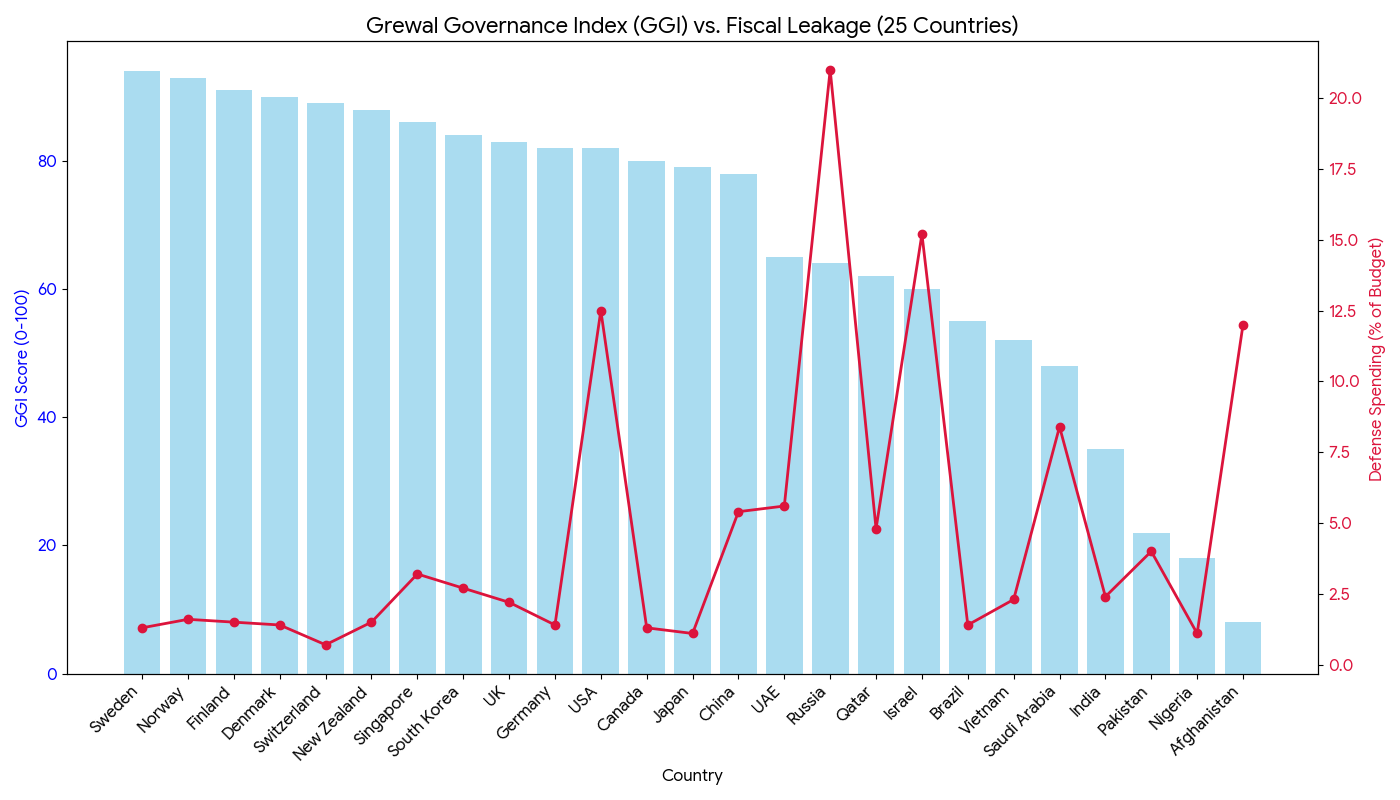
Consolidated Analysis of the "Leakage Index"
- The Overachievers (+): Singapore and South Korea (+5) are the world-class examples of "Conversion Leaders." They take a mid-tier budget and produce top-tier results.
The Consolidated Analysis of the "Leakage Index"
The Overachievers (+): Singapore and South Korea (+5) are the world-class examples of "Conversion
- Underachievers (-): Qatar (-5) remains the outlier of the high-wealth group. Despite its financial power (Rank 7), its outcome (Rank 12) proves that exclusionary social structures act as a primary drain on state efficiency.
- The High-Wealth Friction: Germany and Canada (-3) occupy the "Bureaucratic Leak" zone. They are top performers, but they are "leaking" relative to their massive economic potential due to federalized friction and decentralized delivery.
- The High-Wealth Friction: Germany and Canada (-3) occupy the "Bureaucratic Leak" zone. They are top performers, but they are "leaking" relative to their massive economic potential due to federalized friction and decentralized delivery.
Analysis: Cultural Architecture and the Conversion of Wealth
The Leakage Index serves as a diagnostic tool that moves beyond traditional economics to reveal the underlying cultural architecture of a society. A high positive delta, as seen in Confucian or Universalist societies, indicates a high-trust environment were institutional discipline and meritocracy act as catalysts for fiscal efficiency. Conversely, a significant negative delta exposes the hidden costs of Identity Drain. In societies where majoritarian or theocratic priorities take precedence, wealth is frequently squandered on state preservation rather than individual empowerment. By analyzing these deltas, we can see that "leakage" is rarely a technical error; it is a cultural choice. When a culture shifts toward the collective's welfare—as demonstrated by the Sikh diaspora's values of equality and sharing—the leakage diminishes, and the state's capacity to serve its people naturally rises. In the final analysis, the Leakage Index illuminates how the fate of national wealth is inseparable from a society's cultural DNA. True prosperity is achieved not through technical fixes alone, but by transforming the values and institutions that govern how resources flow. Societies that choose trust, meritocracy, and a shared sense of purpose unlock their full economic potential, while those mired in exclusion and self-preservation inevitably pay the price of stagnation. The path to enduring wealth lies in reshaping the cultural architecture itself—because only then can a nation's resources be harnessed for the collective good, and leakage finally transformed into lasting progress.
Data Availability Statement
The datasets analyzed during the current study, including Fiscal Capacity, Social Spending, and Health/Education metrics—were derived from publicly available resources, including the World Bank Open Data, the International Monetary Fund (IMF) Government Finance Statistics, and UNESCO Institute for Statistics. The original composite scores for the Grewal Governance Index (GGI) and the Leakage Index were generated by the author through the weighted linear composite model described in the Methodology section. All normalized data and calculation spreadsheets supporting the findings of this study are available from the corresponding author upon reasonable request.
References
Harrison, L.E. and Huntington, S.P. (2000) Culture Matters: How Values Shape Human Progress. New York: Basic Books.
Inglehart, R. (2000) 'Culture and Democracy', in Harrison, L.E. and Huntington, S.P. (eds.) Culture Matters. New York: Basic Books.
Landes, D.S. (2000) 'Culture Makes Almost All the Difference', in Harrison and Huntington (eds.) Culture Matters. New York.
Lipset, S.M. (2000) 'Culture and Democracy', in Harrison and Huntington (eds.) Culture Matters.
Patterson, O. (2000) 'Culture and Underdevelopment in the United States', in Harrison and Huntington (eds.) Culture Matters.
Porter, M.E. (2000) 'Attitudes, Values, Beliefs, and the Microeconomics of Prosperity', in Harrison and Huntington (eds.) Culture Matters.
Tu, W. (2000) 'Confucian Values and Economic Development', in Harrison and Huntington (eds.) Culture Matters.
- Manuscript Formatting Rules
Most academic journals, including JDS, require the following standard formatting:
- Spacing: Use Double-spacing throughout the entire document (including the abstract and references). This provides room for editors to make notes or comments.
- Margins: Set all margins (top, bottom, left, and right) to 2.54 cm (1 inch).
- Font: Use a clean, professional serif font like Times New Roman or Palatino at 12-point size.
- Page Numbers: Place page numbers in the top right corner or bottom center.
- Alignment: Use Left-aligned (ragged right) text rather than justified text, as it is easier for reviewers to read.
- The Cover Letter (Introductory Letter)
Yes, you must include a cover letter. This is your chance to "pitch" your work to the Editor-in-Chief. It should be concise and explain why the Grewal Governance Index is a perfect fit for their readership.
Draft Cover Letter for Dr. Grewal
[282590 S. Banta Rd, Tracy, CA 95304]
February 24, 2026
To the Editor-in-Chief, Journal of Development Studies
Subject: Submission of Original Research – "Beyond Per Capita GDP: The Grewal Governance Index (GGI)"
Dear Editor,
I am pleased to submit my original research article, "Beyond Per Capita GDP: The Grewal Governance Index (GGI)," for consideration for publication in the Journal of Development Studies.
This paper introduces a novel metric, the Grewal Governance Index (GGI), which I have developed to move beyond the limitations of aggregate GDP. By re-categorizing fiscal data into "Productive" vs. "Leakage" spending, the study provides a unique synthesis of cultural sociology and economic state capacity. Using a 25-country empirical analysis, the research demonstrates how ethical frameworks—specifically Protestant, Confucian, and Sikh universalism—serve as catalysts for fiscal efficiency.
I believe this work aligns with the journal's mission to explore the intersection of policy, culture, and development. This manuscript is original, has not been published elsewhere, and is not currently under consideration by any other journal.
The manuscript is original, not under consideration elsewhere, and all data sources are publicly available.
Thank you for your time and consideration. I look forward to your response.
Sincerely
Dr. Gurinder Singh Grewal
- Submission Checklist
Before you hit "Submit" on the journal's portal:
- Anonymized Manuscript: Many journals use "Double-Blind" review. You may need to save one version of your paper without your name or title page so the reviewers don't know who wrote it.
- Tables/Figures: Ensure Table 1 and Table 2 are clearly labeled and cited in the text.
- Keywords: Ensure you have listed 5–6 keywords (e.g., Governance, Fiscal Leakage, GGI, Cultural Ethics, Development Metrics).