THE HINDU BOMB: A PRESCRIPTION FOR PROLIFERATION
Inderjit S. Grewal
Introduction
The term “Hindu Bomb” is used in geopolitical discourse to describe India’s nuclear weapons program. Coined especially after India’s first nuclear test in 1974, it implies a connection between India’s Hindu majority population and its nuclear ambitions. India maintains a modern constitution which has remained largely uninvestigated in any meaningful manner. Indian’s official rhetoric surrounding its nuclear weapons has focused on strategic needs, the symbolic and ideological implications of the term which continues to fuel the international debate. This essay explores the historical context, ideological underpinnings, and the implications of associating religion with nuclear power in the South Asian context.
Historical Background
India’s journey into the nuclear arena began in earnest shortly after British exodus from the Indian subcontinent in 1947. The architect of India’s nuclear program, Homi J. Bhabha, envisioned nuclear energy as a tool for national development in a newly post-colonial India. In 1948, the Atomic Energy Commission was established under Jawaharlal Nehru’s leadership, reflecting a commitment to peaceful uses of atomic energy. However, the geopolitical landscape—marked by the 1962 Sino-Indian War and then China’s nuclear test in 1964—shifted India’s priorities toward a potential weapons capability.
However, regional security dynamics, especially the 1962 border war with communist China and the subsequent Chinese nuclear test in 1964, significantly altered India’s strategic calculations. These developments culminated in India’s first nuclear test on May 18, 1974, under the codename “Smiling Buddha.” Though termed a “peaceful nuclear explosion,” it marked India’s entry into the nuclear weapons club and triggered international reactions, including sanctions and deepened non-proliferation concerns. This test occurred under Prime Minister Indira Gandhi’s government, which maintained a “non-aligned” ideological outlook. For over two decades since then, India refrained from further tests, adhering to a policy of nuclear ambiguity amid global non-proliferation pressures.
India’s nuclear journey began in the late 1940s under scientists like Homi Bhabha, driven by a vision of scientific self-reliance rather than religious zeal (Perkovich, 1999). The 1974 “Smiling Buddha” test, described as a “peaceful nuclear explosion,” reflected India’s ambivalence toward weaponization, rooted in Nehruvian ideals of non-alignment and moral opposition to nuclear hegemony (Kapur, 2001). However, the 1998 tests under the Bhartiya Janata Party (BJP)-led government, associated with Hindu nationalism, prompted speculation about religious motivations, especially given the BJP’s ideological ties to the Rastriya Swayamsevak Sangh (RSS) (Perkovich, 1999).
The “Hindu bomb” label gained traction in part due to statements from BJP leaders, such as L.K. Advani, who framed the tests as an assertion of national pride and strength, resonating with Hindu cultural imagery of power and sovereignty (Advani, 1998, as cited in Perkovich, 1999). Critics, including some Indian communists, furthered this narrative by linking the tests to Hindu nationalist agendas, equating them with communalism [1](Rai, 1998). For instance, Vinod Rai of the CPI(ML) [2]called the bomb a “Hindu bomb,” alleging it symbolized anti-Muslim sentiment tied to broader BJP policies (Rai, 1998, as cited in OpIndia, 2020). Yet, these critiques often overlooked the strategic imperatives driving the tests, such as countering Pakistan’s nuclear advancements and China’s regional dominance (Kapur, 2001).
[1] Communalism is described as an ideology stating the division between states (people, groups of people or communities) on the basis of ethnicity, religion, beliefs, values, etc. The difference of two or more religious, ethnic and social communities can sometimes produce clashes in society.
[2] The Communist Party of India (Marxist–Leninist) (CPI(ML)) was an Indian communist party formed by the All India Coordination Committee of Communist Revolutionaries (AICCCR) at a congress in Calcutta in 1969. CPI (ML) saw Naxalbari as the spark that would start a new Indian revolution, and the movement came to be known as “Naxalites”.
[1] Communalism is described as an ideology stating the division between states (people, groups of people or communities) on the basis of ethnicity, religion, beliefs, values, etc. The difference of two or more religious, ethnic and social communities can sometimes produce clashes in society.
[1] The Communist Party of India (Marxist–Leninist) (CPI(ML)) was an Indian communist party formed by the All India Coordination Committee of Communist Revolutionaries (AICCCR) at a congress in Calcutta in 1969. CPI (ML) saw Naxalbari as the spark that would start a new Indian revolution, and the movement came to be known as “Naxalites”.
India was the world’s largest democracy[1], the land of Nehru and Mahatma Gandhi, the altar of nonviolence and nonalignment and pious calls for universal nuclear disarmament. It was also the home of the desperately poor and diseased and yet, of all the poor and backward lands, the one that had most pinned its hopes for the future on nuclear power and the promise of the supposedly peaceful atom. And now this same India was also the first of the less-developed countries to test a nuclear device.
The Islamic Bomb[2]
[1] Carefully examination India’s constitution does not support the idea of India being world’s largest democracy.
[2] Weissmann, S and Krosney, H. The Islamic Bomb: The Nuclear Threat to Israel and the Middle East. New York: 1981, page 161.
The 1998 Nuclear Tests and the Rise of Hindu Nationalism
The shift dramatized more openly in 1998 under the Bhartiya Janata Party (BJP), a political party rooted in Hindutva ideology, which had assumed power in a coalition government. On May 11 and 13, 1998, India conducted a series of five nuclear tests at a site some 70 miles from the Pakistan border at the Pokhran testing facility, in the state of Rajasthan, under an operational code-name, Shakti. Then on May 13, the Indian government announced that it had conducted two more tests, including a claimed thermonuclear device. This is the same site where India carried its first nuclear test in May 1974. Prime Minister Atal Bihari Vajpayee (25 December 1924 – 16 August 2018) declared India a “full-fledged nuclear state,” citing security threats stemming from both Pakistan and China. These tests were met with jubilation domestically, seen as a symbol of national strength and technological achievement.
The BJP’s ascent marked a step forward from the alleged “secular ethos” of previous governments. Hindutva, an ideology championed by the Rastriya Swayamsevak Sangh (RSS) and its affiliates, seeks to define India officially as a Hindu nation. For proponents within this movement, the nuclear tests were not merely a strategic necessity, but a fulfillment of cultural destiny wrapped around Hinduism. Some nationalist voices celebrated the bomb as a “Hindu Bomb,” a term coined in media and political rhetoric to signify the triumph of a Hindu-majority nation over the past colonial and foreign domination. Journalist Chidanand Rajghatta’s 1998 article in The Indian Express titled “The Hindu Bomb” encapsulated this sentiment, framing the tests as a moment of Hindu pride.
The “Hindu Bomb” Narrative: Ideology and Symbolism
Hindu militarism is a genuine and powerful force, influencing Indian foreign policy. It is all the more dangerous because it is unanalyzed, unexposed, and insidious. No one is likely to understand the actions of the Hindu government of India in the international sphere during the last fifteen years without recognizing the existence of a strong under-current of militarism among the people of the country.
Nirad C. Chaudhuri[1]
1965
The association of nuclear weapons with Hindu identity draws from a complex interplay of history, mythology, and politics. Hindu nationalists often invoke ancient texts like the Mahabharata and Ramayana, which describe fantastical weapons such as the Brahmastra a projectile of immense destructive power as evidence of India’s historical
[1] Chaudhuri, Nirad C. The Continent of Circe: An Essay on the Peoples of India. page 104-05: New York: Oxford University Press, 1966.
scientific sophistication. The number of people who died in the Mahabharata War is “1 billion, 660 million, and 20,000 men” (1,660,020,000) while the survivors numbered no more than 24,165 told by Yudhishthira, truth striving hero of the epic. The kill-count of about 1,660,020,000, men dying in the Mahabharata War is a specific detail given in the epic text itself. It’s important to remember that the Mahabharata is an ideological and mythological text underpinning war doctrine and not a historical record. They resonate with a narrative of reclaiming a glorious India’s past (that never existed) disrupted by centuries of Muslim and British colonial rules only to be resurrected in today’s Hindu infested India.
The 1998 tests occurred against the backdrop of heightened communal tensions, notably the 1992 demolition of the Babri Masjid (Mosque) by Hindu activists, an event that bolstered the BJP’s rise. Critics, including leftist and secular intellectuals, accused the BJP of linking the nuclear program to Hindutva [1]to consolidate domestic support. For instance, material on social media and articles from outlets like OpIndia have highlighted how Indian communists labeled the bomb a “Hindu Bomb,” tying it to the Babri Mosque demolition as part of a critique of BJP’s policies. This framing, however, oversimplifies the strategic imperatives—such as Pakistan’s nuclear advancements—that drove the tests.
Internationally, the “Hindu Bomb” label raised concerns about religious extremism influencing nuclear policy. Pakistan, which conducted its own tests weeks later in May 1998, dubbed its arsenal the “Islamic Bomb,” intensifying the perception of a religious rivalry in South Asia. Western analysts worried that intertwining nuclear power with religious nationalism could destabilize the region, though India’s official stance emphasized deterrence, not ideology.
Nirad C. Chaudhuri’s (23 November 1897 – 1 August 1999) The Continent of Circe (1965) offers a critical analysis of Indian society, challenging the so-called prevalent notion of India’s inherent pacifism. He argues that militarism has been a consistent aspect of Indian (Hindu) civilization, deeply embedded in its cultural and historical fabric.
Chaudhuri posits that violence and warfare are integral to India’s history and cultural identity, tracing this trait from ancient times through various dynasties. He cites examples such as Emperor Ashoka’s conquest of Kalinga and the military exploits of the Guptas, suggesting that these instances reflect a broader pattern of militaristic behavior in Indian society. This perspective is further supported by literary evidence from epics like the Mahabharata and Ramayana, which depict large-scale wars and valorize martial prowess.
In contemporary times, discussions around Hindu nationalism and its influence on India’s foreign policy have gained prominence. Some scholars argue that Hindu nationalist ideologies have introduced a more assertive and security-oriented approach to foreign policy, emphasizing India’s civilizational identity and strategic autonomy.
[1] Hindutva is a political ideology encompassing the cultural justification of Hindu nationalism and the belief in establishing Hindu hegemony within India.
However, others contend that while Hindu nationalist rhetoric is present, India’s foreign policy remains largely pragmatic, driven by geopolitical and economic considerations rather than ideological imperatives.
Chaudhuri’s insights from The Continent of Circe provide a historical context for understanding these contemporary debates, highlighting the enduring complexities of militarism and ideology in shaping of India’s national and international identity.
Domestic and Global Reactions
Domestically, the 1998 tests enjoyed broad support across political lines, transcending the BJP’s base. Scientists like A.P.J. Abdul Kalam, who later became India’s President, were hailed as national heroes, underscoring the program’s technical rather than religious roots. However, dissenters like Arundhati Roy, in her essay “The End of Imagination,” condemned the tests as a descent into militaristic chauvinism, arguing that they betrayed alleged “India’s Gandhian legacy of nonviolence.” Roy’s critique implicitly challenged the “Hindu Bomb” narrative by framing it as a universal ethical failure, and not a religious triumph. Today Roy most likely changed her views of Gandhi’s legacy of violence because Gandhi recognized the atom bomb’s supremacy and justified violence over cowardice.
Globally, the response was overwhelmingly negative. The United States imposed economic sanctions, and the United Nations Security Council condemned the tests. The “Hindu Bomb” label fueled fears of proliferation driven by identity politics, though India maintained its no-first-use policy and commitment to global disarmament—a stance at odds with the aggressive rhetoric of some nationalists. These 1998 tests caught the world in shock and jolted many to include President Bill Clinton. It is indeed ironic that the first test evoked a similar response. In the words of Mr. Raja Ramanna, the architect of the 1974 explosion:
[The 1974 explosion] came as a surprise to the world. They hadn’t expected such an achievement from a developing country … their criterion for measuring success was different in the sense that they judged the success of a country by its material acquisitions and its overt proof of development … India didn’t conform to any of these, and in this context alone it seemed somewhat relevant when the Western world expressed bewilderment, coupled with fear and panic at the success of Pokhran[1].
India cited multiple justifications for its nuclear tests and bomb program:
[1] Ramanna, Raja. Years of Pilgrimage. Delhi: Viking, 1991, page 93-93. 1991
However, others contend that while Hindu nationalist rhetoric is present, India’s foreign policy remains largely pragmatic, driven by geopolitical and economic considerations rather than ideological imperatives.
Chaudhuri’s insights from The Continent of Circe provide a historical context for understanding these contemporary debates, highlighting the enduring complexities of militarism and ideology in shaping of India’s national and international identity.
Domestic and Global Reactions
Domestically, the 1998 tests enjoyed broad support across political lines, transcending the BJP’s base. Scientists like A.P.J. Abdul Kalam, who later became India’s President, were hailed as national heroes, underscoring the program’s technical rather than religious roots. However, dissenters like Arundhati Roy, in her essay “The End of Imagination,” condemned the tests as a descent into militaristic chauvinism, arguing that they betrayed alleged “India’s Gandhian legacy of nonviolence.” Roy’s critique implicitly challenged the “Hindu Bomb” narrative by framing it as a universal ethical failure, and not a religious triumph. Today Roy most likely changed her views of Gandhi’s legacy of violence because Gandhi recognized the atom bomb’s supremacy and justified violence over cowardice.
Globally, the response was overwhelmingly negative. The United States imposed economic sanctions, and the United Nations Security Council condemned the tests. The “Hindu Bomb” label fueled fears of proliferation driven by identity politics, though India maintained its no-first-use policy and commitment to global disarmament—a stance at odds with the aggressive rhetoric of some nationalists. These 1998 tests caught the world in shock and jolted many to include President Bill Clinton. It is indeed ironic that the first test evoked a similar response. In the words of Mr. Raja Ramanna, the architect of the 1974 explosion:
[The 1974 explosion] came as a surprise to the world. They hadn’t expected such an achievement from a developing country … their criterion for measuring success was different in the sense that they judged the success of a country by its material acquisitions and its overt proof of development … India didn’t conform to any of these, and in this context alone it seemed somewhat relevant when the Western world expressed bewilderment, coupled with fear and panic at the success of Pokhran[1].
India cited multiple justifications for its nuclear tests and bomb program:
[1] Ramanna, Raja. Years of Pilgrimage. Delhi: Viking, 1991, page 93-93. 1991
China Threat: Long-standing border disputes and China’s nuclear arsenal, compounded by its 1962 victory over India and support for Pakistan.
Pakistan Conflict: Ongoing hostility and past wars with Pakistan, including tensions over Kashmir.
Kashmir Tensions: Allegations of terrorism support by Pakistan and persistent regional instability.
Regional Prestige: A show of nuclear strength to command respect from neighboring countries.
Demonstrated Capability: Proving India’s ability to weaponize its nuclear program through underground tests.
National Reassurance: Boosting public confidence in national security amidst regional nuclear uncertainty.
National Pride: Enhancing a sense of prestige and identity tied to nuclear power.
Nuclear Club Aspirations: Gaining entrance into the elite group of nuclear-armed states.
UNSC Membership Ambition: Strengthening India’s case for permanent membership on the UN Security Council.
Credible Deterrence: Establishing a flexible, minimally sufficient deterrent—open to future recalibration.
Moral Disarmament Position: Framing its nuclear path as “protest against nuclear apartheid,” positioning itself morally through a “Nuclear Satyagraha” for eventual so-called global disarmament.
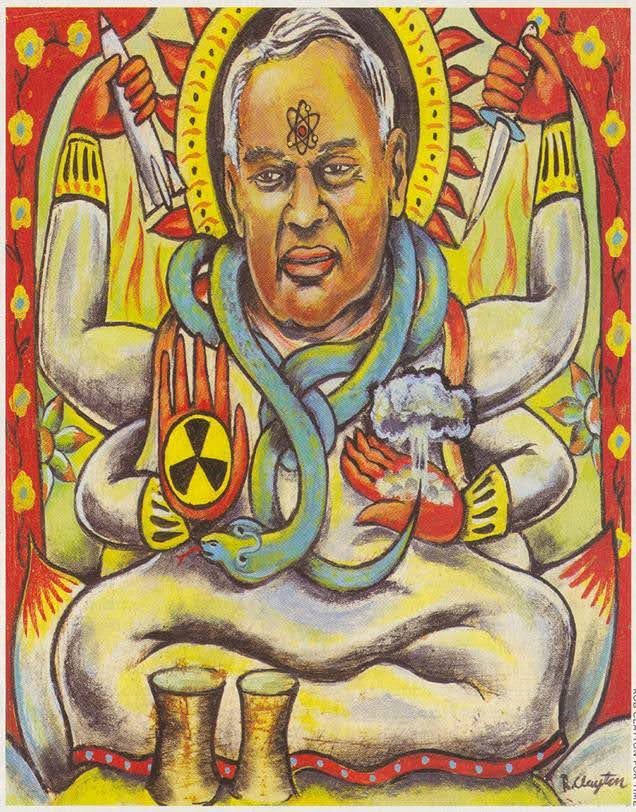
Senior US officials rejected India’s rationales without offering alternative explanations for its actions. Senator Jesse Helms suggested that India’s nuclear actions posed a threat to the US, while Insight magazine’s James P. Lucier attributed India’s motives to internal ethnic issues and warned of potential tragedy. Some blamed the ruling BJP, with Time magazine caricaturing Prime Minister Vajpayee as a “Nuclear Yogi.” Vajpayee defended India’s nuclear policy in Indian Parliament, citing cultural obligations and quoting the Bhagavad-Gita.
Action is a process to reach the goal; action may reflect tumult but when measured and focused, will yield its objective of stability and peace.
India’s 1998 nuclear tests prompted Pakistan to conduct its own tests on May 28, escalating the South Asian crisis. The Bulletin of the Atomic Scientists set the “Doomsday Clock” to nine minutes to midnight, marking the 16th adjustment since 1947 due to heightened nuclear risks.
Background, Development & Ideology of Indian nuclear Program
Surprisingly, despite ruling India for two centuries, the British never truly understood—let alone connected with—the Hindu mindset.
Nirad C. Chaudhuri[1]
1965
The “Hindu Bomb” narrative intertwines strategic imperatives with cultural symbolism. Hindu nationalists often cite ancient texts like the Mahabharata, which describes the Brahmastra—a mythical weapon of mass destruction—as evidence of India’s historical scientific legacy. For instance, RSS ideologue M.S. Golwalkar (19 February 1906 – 5 June 1973) claimed in Bunch of Thoughts (1966) that ancient India possessed advanced knowledge suppressed by foreign invaders (Golwalkar, p. 45). While such claims are historically unverifiable, they resonate with a narrative of reclaiming a lost golden age, a theme echoed in BJP rhetoric post-1998.
The tests’ timing reinforced this framing. The BJP’s 1998 election manifesto promised to “exercise the option to induct nuclear weapons” (BJP Manifesto, 1998, p. 34), aligning with its muscular nationalism. Senior BJP leader L.K. Advani linked the tests to national pride, stating, “Shakti symbolizes India’s strength rooted in its civilization” (Advani, Press Conference, May 1998, Times of India, May 15). Critics, however, saw this as a politicization of a program built by alleged secular governments of the past and diverse scientists, including A.P.J. Abdul Kalam (15 October 1931 – 27 July 2015), a Muslim who oversaw the 1998 tests as DRDO[2] chief (Kalam & Tiwari, 1999, Wings of Fire, p. 158).
Domestic Reception and Dissent
Domestically, the tests enjoyed widespread support, transcending political divides. Opinion polls by India Today in May 1998 showed 91% approval, reflecting a surge of national pride (India Today, May 25, 1998, p. 12). Scientists like Kalam and R. Chidambaram, head of the Atomic Energy Commission, were celebrated as national icons.
Broader Implications and Legacy
The “Hindu Bomb” label poses enduring questions about identity and power. Strategically, the 1998 tests bolstered India’s deterrence against Pakistan and China, evidenced by its 2003 formalization of a nuclear doctrine emphasizing credible minimum
[1] Chaudhuri, Nirad C. The Continent of Circe: An Essay on the Peoples of India. New York: Oxford University Press, 1965, page 87.
[2] The Defence Research and Development Organisation is an agency under the Department of Defence Research and Development in the Ministry of Defence of the Government of India, charged with the military’s research and development, headquartered in Delhi, India.
deterrence (Cabinet Committee on Security, January 4, 2003). Yet, the religious framing risks alienating India’s 200 million Muslims and other minorities, contradicting so called its secular constitution.
Globally, the tests challenged the NPT[1] regime, prompting debates about nuclear legitimacy for non-signatories.[2] Scholars like George Perkovich argued that India’s program reflects “defiant nationalism” rather than religious zeal (Perkovich, 1999, p. 405). The “Hindu Bomb” thus serves as a lens for examining how cultural narratives shape technological milestones, a phenomenon not unique to India—Pakistan’s “Islamic Bomb” and Israel’s undeclared arsenal and Iran’s potentials Shia flavored Islamic bomb offer parallels.
Westan countries have failed to understand India’s true motives. This recurring shock suggests a deeper gap in our understanding—perhaps rooted in a limited grasp of Hinduism, which shapes India’s national psyche. This section explores the ideological forces behind India’s pursuit of the bomb, particularly the idea of a “Hindu bomb.”
- Evolution of Modern Hinduism:
The Hindu dreams that he will eventually be able to hoist the West with its own petard, and he is not such a fool as many might imagine.
Nirad C. Chaudhuri[3]
1965
The evolution of Modern Hinduism was significantly shaped by The British colonial rule, Christian missionary efforts, and Western education. Colonial policies—especially those led by figures like Lord Macaulay—displaced traditional Hindu and Islamic education systems, introducing English and Western sciences as suitable replacements. This led to greater communication among the Indians, particularly the high-caste Hindus which led to a resurgence Hindu cultural value. The translation of Hindu texts, notably the Bhagavad Gita, played a pivotal role in this revival. Though virtually unknown in India before its 1785 English translation, the Gita gained prominence abroad and eventually returned to inspire a new wave of modern Hindu thought and nationalism. The fusion of Western science and Hindu ideology gave rise to reinterpretations to such as “Hindu Physics” and “Hindu Chemistry,” promoting the idea of Hinduism as a rational, scientific faith. This ideological shift alienated the Muslim minority, contributing to rising tensions and eventually leading to
[1] The Treaty on the Non-Proliferation of nuclear weapons, commonly known as the Non-Proliferation Treaty or NPT, is an international treaty whose objective is to prevent the spread of nuclear weapons and weapons technology, to promote cooperation in the peaceful uses of nuclear energy, and to further the goal of achieving nuclear disarmament and general and complete disarmament.
[2] India has not signed Treaty on the Non-Proliferation of nuclear weapons. India is also known as non-signatory.
[3] Chaudhuri, Nirad C. The Continent of Circe: An Essay on the Peoples of India. New York: Oxford University Press, 1966, page 79.
the creation of Pakistan—and with it, the pursuit of an Islamic bomb in response to what became known as the Hindu bomb.
- Age of The Atom Bomb:
Modern Hindus had not forgotten their Mahabharata. They presented Colonel Rusk who commanded the task force of the 322nd American Air Division in India with a model of the battle of Kurukshetra!
Nirad C. Chaudhuri[1]
1966
In 1945, the atomic bombings of Hiroshima and Nagasaki in Japan marked the start of the nuclear age, with profound global effects—including on Modern Hinduism in post-colonial India. Notably, J. Robert Oppenheimer, director of the Los Alamos Project, recalled a verse from the Bhagavad-Gita at the time of the first atomic test, reflecting the unexpected spiritual and philosophical ties between Hinduism and nuclear science. Later he recalled two lines from the Bhagavad-Gita in which Hindu god, Krishna is the spokesman:
I am become Death, the Shatterer of worlds; Waiting that hour that ripens to their doom.16
During the McCarthy era, Robert Oppenheimer, father of the atom bomb, quoted the Bhagavad-Gita before the House Un-American Activities Committee, referencing its vivid imagery to justify his role in developing nuclear weapons. Fascinated by Hindu philosophy, he learned Sanskrit to study the Mahabharata and corresponded with Jawahar Lal Nehru (14 November 1889 – 27 May 1964), who later invited him to India after his security clearance was revoked. Oppenheimer’s link to Hindu sacred texts inspired reinterpretations within the Modern Hinduism, portraying ancient scriptures like the Mahabharata as records of real, even nuclear, warfare—recasting the Hindu past as one of victorious, advanced power. This blending of ancient mythology with modern science fueled nationalist pride and ideological revival. Mahatma Gandhi (2 October 1869 – 30 January 1948), being a major prophet of Modern Hinduism, on 27 May 1947 in a speech delivered during the Prayer Meeting in New Delhi elaborated:
But today they [Sikhs) are thinking of the sword. They do not realize that the age of the sword is past. They do not realize that no one can be saved by the strength of the sword. This Is the age of the atom bomb.20 (Emphasis added)
[1] Chaudhuri, Nirad C. The Continent of Circe: An Essay on the Peoples of India. New York: Oxford University Press, 1966, page 114.
Later, he asserted that in the age of the Atom Bomb, “the sword was a rusty weapon.” Decades later, with nuclear weapons stockpiled, Indian leaders—particularly the staunch nuclear hawks—did not hesitate to invoke Mahatma Gandhi to justify their stance. Drawing strength from Gandhi’s own writings, they cited his somewhat paradoxical essays titled “The Doctrine of the Sword,” penned in the pre-atomic era of the 1920s, to support the development of more atomic bombs.
Gandhi wrote:
- “I do believe that where there is only a choice between cowardice and violence, I would advise violence. Thus, when my eldest son asked me what he should have done had he been present when I was almost fatally assaulted in 1908—whether he should have run away and let me be killed, or used his physical strength to defend me—I told him it was his duty to defend me, even by using violence. Hence, I took part in the Boer War, the so-called Zulu Rebellion, and the Great War. I also advocate arms training for those who believe in violence. I would rather have India take up arms to defend her honor than remain a helpless witness to her own dishonor in cowardice. Let me not be misunderstood. Strength does not come from physical capacity; it comes from an indomitable will. The average Zulu, in terms of bodily strength, may be superior to the average Englishman, but he still fears the English boy’s revolver. He fears death, and that fear renders him powerless, despite his strong physique.”
- “It is better to use brute force than to betray cowardice. It is better for India to arm itself and take the risk than to avoid arms out of fear. That was why I joined the Boer War and aided the government during the Zulu Rebellion. During the last World War, I also supported the British, both in England and India, including recruitment efforts. Forgiveness is the virtue of the brave. Only the strong can truly forgive. Likewise, only one who is capable of enjoying pleasures can qualify to be a brahmachari by restraining desires. There is no such thing as the mouse forgiving the cat. India’s soul-force will be proven only when it refuses to fight despite having the strength to do so. This ‘strength to fight’ does not mean physical might alone. Anyone with courage and who has overcome the fear of death possesses such strength. I have seen sturdy Negroes cowering before white boys—afraid not of the boys themselves, but of their revolvers.”
- DRAFTING FOR THE AGE OF HINDU BOMB:
Modern defense as well as modern industry require scientific research both on a broad scale and in highly specialized ways. If India has not got highly qualified scientists and up-to-date scientific institutions in large numbers, it must remain a weak country incapable of playing a primary part in a war.
Jawaharlal Nehru[1]
1946.
In 1942, Gandhi named Nehru as his successor, confident in his loyalty. On June, 1947, at a prayer speech, Gandhi made clear his position: “If we had the atom bomb, we would have used it against the British.”[2] After British left Indian subcontinent, Nehru, a high-caste Brahmin, led India into the nuclear era despite the nation’s poverty and lack of infrastructure. Under the guise of peaceful development and Western-style progress, India quietly pursued nuclear ambitions, promoting Modern Hinduism[3] as a national ideology while projecting a non-violent, democratic image to the world. Drafting for the “age of Hindu bomb” encompassed the following steps:
- Atomic Energy Bill. In 1948, Prime Minister Nehru introduced the Atomic Energy Bill, seeking centralized control, secrecy, and severe penalties, limiting nuclear policy to a select few without legislative oversight. Despite its peaceful intent, the Bill faced little opposition in the Constituent Assembly.
- V. Kamath framed atomic energy through a Hindu Nationalist lens, linking it to ancient Hindu wisdom, while Nehru emphasized a global “world-time” perspective, urging India to harness atomic power to avoid historical backwardness. Both views, though seemingly divergent, aligned within Modern Hinduism’s spectrum.
- V. Kamath’s parochial nationalism and Nehru’s internationalist stance differed only in degree. S.V. Krishnamurthy Rao questioned the restrictive controls for peaceful purposes, comparing India’s approach to less restrictive British and American laws. Nehru deflected, stressing timing and geopolitical opportunity, revealing the Bill’s underlying strategic motives, hinting at the “Hindu Bomb” agenda. Heated exchange between these two personalities exposed the true nature of drafting for the Age of Hindu Bomb:
RAO: May I know if secrecy is insisted upon even for research for peaceful purposes?
NEHRU: Not theoretical research. Secrecy comes in when you think in terms of the production or use of atomic energy. That is the central effort to produce atomic energy.
RAO: In the Bill passed in the United Kingdom secrecy is restricted only for defense purposes.
[1] Abraham, Itty. The Making of Indian Atomic Bomb: Science Secrecy and the Postcolonial State. New York: zed Books, 1998. A quote mentioned on page 49.
[2] Singh, G.B. Gandhi Behind the Mask of Divinity. Amherst, New York, 2004, page 314, reference # 17.
[3] Modern Hinduism is a combination of ideologies like Theosophy, Communism, and Fascism. The rise of Hindu nationalism based upon Modern Hinduism represents the politicization and militarization of traditional Hinduism. Religious imagery and new temples like the Bharat Mata Mandirs symbolize the merging of Hindu devotion with nationalist propaganda. Modern Hinduism often fostering violence against non-Hindu communities. RSS and its global networks active in North America pose serious threats to religious pluralism and social harmony.
NEHRU: I do not know how to distinguish between the two [peaceful and defense purposes].32
From the start, India’s atomic program had a military aspect. Nehru’s stance reflected Modern Hinduism’s blurring of lines between violence and nonviolence. Despite some debate, the bill passed with support for its military intent. The industrial revolution in India at its most disinterested is an expression of anti- European and anti-Western nationalism. It is the realization of the desire, and now the policy, of the Hindus to get even with the West and take revenge for the dead European imperialism by adopting its technology and organization.
Nirad C. Chaudhuri[1]
1965
[1] Chaudhuri, Nirad C. The Continent of Circe: An Essay on the Peoples of Indla. New York: Oxford University Press, 1965, page 78.
Background, Development & Ideology of Pakistani Nuclear Program
If India builds the bomb, we will eat grass or leaves, even go hungry. But we will get one of our own. We have no alternatives.
Zulfikar Ali Bhutto[1]
1965
While India portrayed its nuclear program as peaceful to the West, Pakistan saw through the facade, shaped by centuries of Islamic rule, Hindu-Muslim conflict, and the trauma of Partition and the multi wars. The 1971 war, leading to Bangladesh’s independence, marked a major blow to Pakistan and a symbolic victory for Modern Hinduism over Islam. Pakistan, driven by deep historical memory and religious rivalry, suspected India’s nuclear ambitions early on and viewed them as a serious threat.
Foundations for the Islamic Bomb
We know that Israel and South Africa have full nuclear capability. The Christians, Jewish and Hindu civilizations have this capability. The communist powers also possess it. Only the Islamic civilization was without it, but that position was about to change.
Zulfikar Ali Bhutto[2]
1979
It is our right to obtain this technology [nuclear]. And when we acquire this technology, the entire Islamic world will possess it with us.
General Zia ul-Haq[3]
The U.S. shared nuclear knowledge with both India and Pakistan under the “Atoms for Peace” program. While India advanced quickly, Pakistan ramped up efforts after its
[1] Weissmann, S and Krosney, H. (1981). The Islamic Bomb: The Nuclear Threat to Israel and the Middie East. New York, page 161.
[2] Weissmann, S and Krosney, H. (1981). The Islamic Bomb: The Nuclear Threat to Israel and the Middie East. New York, page 39.
[3] Burrows, W and Windrem, R. Critical Mass: The Dangerous Race for Superweapons in a Fragmenting World. New York: Simon & Schuster, 1994, page 360.
1971 defeat.[1] In 1972, Prime Minister Zulfikar Ali Bhutto launched Pakistan’s nuclear weapons program, later supported by Islamic nations and other foreign suppliers. Dr. Abdul Qadeer Khan, using insider access in Europe, smuggled key centrifuge designs to Pakistan. By the late 1980s, with China’s help, Pakistan had a complete nuclear arsenal. Despite U.S. pressure, Pakistan refrained from testing until India’s 1998 nuclear tests forced its hand.
The Threat of Proliferation:
The Indian subcontinent is the most dangerous place on Earth. It is the incubator of racial and religious hatred that is more virulent and persistent than any biological epidemic (though it, too, could be unleashed in a war). The slum of every city of consequence is a purgatory in which rampaging Hindu and Muslim fundamentalists search for their opposite number and kill them. The race for superweapons is therefore driven as much by sheer hatred as by geopolitical considerations. While both sides have invented elaborate excuses for developing nuclear weapons–strategic deterrence, for example-—their real purpose is genocide.
Critical Mass [2]1994
That is why even the early phase of the nuclear epidemic is dangerous and the Israeli and Pakistani bombs could be the death of us.
Nuclear Nightmare [3]1979
India’s nuclear development is often seen as a strategic response to China (1964) and regional threats, culminating in the 1974 and 1998 tests. While this narrative aligns with global patterns, deeper analysis suggests India’s nuclear ambition is ideologically driven by Modern Hinduism, symbolically reflected in its reactor designs. This ideological push has alarmed the Islamic world—especially Pakistan—triggering its own nuclear response. The ongoing dynamic risks wider proliferation, especially in the Middle East. The real solution lies in compelling both India and Pakistan to fully renounce nuclear weapons.
[1] The Indo-Pakistani war of 1971, also known as the third India-Pakistan war, was a military confrontation between India and Pakistan that occurred during the Bangladesh Liberation War in East Pakistan from 3 December 1971 until the Pakistani capitulation in Dhaka on 16 December 1971.
[2] Burrows, W and Windrem, R. Critical Mass: The Dangerous Race for Superweapons in a Fragmenting World. New York: Simon & Schuster, 1994, page 351.
[3] Calder, Nigel. Nuc1ear Nightmares: An Investigation into Possible Wars. New York: Penguin Books, 1979, page 83.
Background, Development, & Ideology of Zionism and Israel’s Nuclear Program
Israel emerged in the late 19th century under Theodor Herzl as a response to rising antisemitism in Europe, advocating for a Jewish homeland, eventually centered on Palestine. Its core ideology emphasized Jewish nationhood and the necessity of a sovereign state for survival. Growing nationalism and events like the Balfour Declaration (1917) strengthened the movement.
The development of Israel involved early Jewish migration, institution-building, and international support following the Holocaust. Israel declared independence in 1948, leading to immediate conflict with Arab neighbors and long-term occupation issues after the 1967 war.
Zionist security ideology, shaped by Holocaust trauma and regional hostilities, focused on survival, perceived existential threats, and the doctrine of self-reliance, prompting Israel to seek military and nuclear superiority to ensure its existence.
Israel, though never officially confirming its nuclear arsenal, is widely believed to possess nuclear weapons. Zionism, as both a political and religious ideology, played a key role in shaping Israeli security doctrine. Israel’s nuclear strategy, including the policy of ambiguity, is influenced by a belief in existential threat from its neighbors—many of which are predominantly Muslim—and by a theological commitment to the survival and protection of the Jewish people.
Foundations for the Islamic Bomb
In the 1950s, Prime Minister David Ben-Gurion secretly authorized efforts to develop nuclear capabilities. His motto was “Never again will we be helpless.” France, after the Suez Crisis (1956), collaborated with Israel, helping construct the Dimona nuclear facility in the Negev desert. France provided the nuclear reactor, heavy water, and technological expertise.
Secrecy and Policy: Nuclear Ambiguity (“Amimut”): Israel neither confirms nor denies having nuclear weapons. This strategy allows deterrence without inviting formal retaliation or international sanctions.
Development of Nuclear Capabilities
By the late 1960s, Israel is believed to have acquired its first operational nuclear weapons. During the Yom Kippur War (1973), nuclear preparedness reportedly influenced U.S. decision-making to resupply Israel. Deters existential threats from neighboring states. Provides a “last resort” safeguard in case of national catastrophe. Israel is believed to possess between 80–400 nuclear warheads. Delivery systems include aircraft, land-based missiles, and submarines (second-strike capability).
Impact on Regional and Global Politics
- Regional Tensions:
- Israeli nuclear opacity has fueled arms races (e.g., Iraq’s Osirak reactor, Iran’s nuclear program).
- Arab states criticize the double standard: Israel remains outside the Nuclear Non-Proliferation Treaty (NPT).
- International Relations:
- Israel’s nuclear status is tolerated by key allies like the U.S.
- However, it remains a sensitive subject in U.S., European, and UN diplomatic circles.
- Influence on U.S.-Israel Ties:
- Strategic partnership, particularly under the umbrella of shared security interests.
- Israel’s nuclear capability is seen as part of maintaining U.S. hegemony in the Middle East.
Current Situation and Future Outlook
- Strategic Deterrence:
- Israel continues to modernize its delivery systems quietly.
- It aims to maintain its “edge” amid emerging regional threats like Iran.
- Potential Risks:
- Risk of nuclear proliferation in the Middle East.
- Growing calls for a “Nuclear Weapons-Free Middle East” from Arab states.
Background, Development & Ideology of Irani Nuclear Program
Iran’s nuclear ambitions are shaped by a complex interplay of Shia Islamic ideology, nationalism, and strategic considerations. Since the 1979 Islamic Revolution, Iran has been governed by a theocratic regime that integrates religious authority into all aspects of governance. Supreme Leader Ayatollah Ali Khamenei has issued a fatwa declaring nuclear weapons un-Islamic, yet suspicions persist internationally regarding Iran’s true intentions. The tension between Iran’s religious prohibition and its pursuit of nuclear technology reflects deeper ideological divisions within the regime and illustrates how religious doctrine can both constrain and justify nuclear development.
Iran’s nuclear program started under Shah Mohammad Reza Pahlavi (1950s–1970s) with U.S. support (as part of the Atoms for Peace program). Shah’s aim was energy diversification and prestige; he wanted up to 20 nuclear reactors and even hinted at possible weaponization. After the 1979 Islamic Revolution, Ayatollah Khomeini initially halted the program, seeing nuclear weapons as un-Islamic and extravagant. But Iran-Iraq War (1980–88) changed perceptions: chemical attacks by Iraq and regional insecurity reignited interest in nuclear capabilities.
Ideological Foundation: Influence of Shia Islam
Shia political thought strongly emphasizes resisting injustice and protecting the rights of the Mazlum[1] (oppressed). This is rooted in their belief that the only legitimate government is one that follows God’s righteous will, advocating for social justice and equality. The Battle of Karbala is a key example of standing up against injustice, even in the face of martyrdom. Shia political thought sees resistance against unjust rulers and systems as a moral and spiritual duty, drawing from the Quran and teachings of the Prophet Muhammad and his descendants. Nuclear technology is seen as a symbol of resisting Western domination. Shia Islam encourages independence from foreign powers, aligning with Iran’s push for indigenous nuclear technology. Iran frames its nuclear program as strictly peaceful, justified by Islamic law forbidding weapons of mass destruction but allowing defensive science.
In Shia tradition, taqiyya[2] permits concealment of one’s true intentions under threat. Some Western analysts argue Iran may use this principle in negotiations, though Iran officially denies any secret military ambitions.
Strategic and Theological Justifications
- “Science is worship”: Islamic scholars in Iran often argue that scientific advancement, including nuclear technology, is a form of religious duty.
[1] Mazlum is an Arabic term for “oppressed, ill-treated, injured, sinned-against”
[2]In situations of political oppression, Shiites have historically practiced Taqiyya (dissembling or hiding their true beliefs) to protect themselves and their faith, while still maintaining their commitment to resistance.
- Defensive Deterrence: Building robust scientific and possibly latent nuclear capability is seen as deterrence against existential threats (e.g., Israel, U.S.).
- Imam Mahdi’s Return: Some religious leaders believe preparing a powerful Islamic society (including technological mastery) is necessary for the eventual return of the Mahdi, a messianic figure in Shia eschatology.
Iran’s nuclear program blends national security needs, religious justifications, and Shia political philosophy. Shia Islam provides both moral restrictions and motivations for Iran’s scientific nuclear pursuits while resisting Western hegemony and promoting national sovereignty.
Background, Development & Ideology of Saudi Arabia’s Nuclear Program
Saudi Arabia’s interest in nuclear technology began in the 1970s, primarily for peaceful purposes like energy and desalination, given its rapidly growing population and water scarcity. However, regional tensions especially with Iran’s nuclear advancements and Israel’s undeclared nuclear arsenal have pushed Saudi Arabia to consider a more strategic dimension to its nuclear program. In 2015, Saudi Arabia launched a major initiative called the King Abdullah City for Atomic and Renewable Energy (K.A. CARE) to formally push nuclear energy development. Riyadh signed multiple agreements with countries offering nuclear technology but has not yet accepted the strict “gold standard” 123 Agreement with the U.S., which would restrict enrichment and reprocessing.
if Iran developed a nuclear bomb, Saudi Arabia would “follow suit as soon as possible.”
Crown Prince Mohammed bin Salman[1]
Ideology Behind the Saudi Arabia’s Nuclear Program
Saudi Arabia’s nuclear ambitions are not just technical or strategic; they are deeply ideological:
- National Security and Regional Balance
- The monarchy sees nuclear capability (even latent capability) as essential to maintaining a balance of power with Iran and Israel.
- Nuclear technology symbolizes modern sovereignty and strategic independence.
- Preservation of Regime Stability
- In Saudi political ideology, maintaining the monarchy’s survival is paramount.
- A nuclear program is viewed as a deterrent against both external threats and internal destabilization caused by regional conflicts.
- Islamic Leadership
- As the Custodian of the Two Holy Mosques (Mecca and Medina), Saudi Arabia’s leadership feels responsible for defending Islamic lands.
[1] https://www.bbc.com/news/world-middle-east-43419673
- Some ideological narratives frame nuclear capability as necessary to protect Islam from external aggression, especially given Iran’s Shia-majority regime and Saudi Arabia’s Sunni-Wahhabi orientation.
The Danger of Religious Extremism and Non-State Actors
The most alarming intersection of religion and nuclear weapons arises from the potential acquisition of nuclear technology by extremist groups. Religious militancy, especially where groups interpret holy texts to justify mass destruction, poses a unique and urgent threat.
- Terrorist Organizations
Groups like Al-Qaeda, ISIS, and others have openly expressed interest in acquiring weapons of mass destruction. Their religious justification for mass violence means that traditional deterrence models may not apply, as such actors are not concerned with mutual destruction or rational statecraft.
- State-Sponsored Extremism
There are concerns that religiously motivated elements within nuclear states could facilitate proliferation. This risk is particularly relevant in countries where the military, intelligence, or nuclear establishment has strong ideological leanings.
Suitcase Nukes and Terrorist Organizations
A suitcase nuclear device[1] is a tactical nuclear weapon that is portable enough that it could use a suitcase as its delivery method. Portable nuclear weapons often referred to as “suitcase nukes” are secretly transported across borders and placed near strategic targets or used to render areas uninhabitable. Attention to portable nuclear devices peaked
Following an interview with CBS newsmagazine Sixty Minutes on 7 September 1997, late governor of Krasnoyarsk Krai and former Russian Security Council Secretary, General (Ret.) Alexander Lebed would claim that the Russian military had lost track of more than a hundred out of a total of 250 “suitcase-sized nuclear bombs”. Lebed stated that these devices were made to look like suitcases, and that he had learned of their existence only a few years earlier. On 10 September, the Ministry for Atomic Energy of the Russian Federation (MINATOM)[2] rejected Lebed’s claims as baseless. Russian Prime Minister Viktor Chernomyrdin “ridiculed Lebed’s account as
[1] The term “suitcase (nuclear/atomic) bomb” was introduced during the 1950s with the prospect of reducing the size of the smallest tactical nuclear weapons for the delivery in actual suitcases.
[2] The Ministry for Atomic Energy of the Russian Federation was established on January 29, 1992 as a successor of the Ministry of Nuclear Engineering and Industry of the USSR.
“absolute stupidity” and said that “all Russian nuclear weapons are under the total and absolutely reliable control of the Russian armed forces.
If detonated in a populated area, even a low-yield suitcase nuke could cause catastrophic damage. A one-kiloton explosion could destroy structures within a half-mile radius and result in tens of thousands of casualties, depending on the population density. Additionally, the radioactive fallout would pose long-term health and environmental risks.
An act of nuclear terrorism could rip the heart out of a major city, and cause ripple effects throughout the world. The government of the country attacked would face desperate decisions: How to help the city attacked? How to prevent further attacks? How to respond or retaliate?
Terrorists—either those who committed the attack or others—would probably claim they had more bombs already hidden in other cities (whether they did or not), and threaten to detonate them unless their demands were met. The fear that this might be true could lead people to flee major cities in a large-scale, uncontrolled evacuation. There is very little ability to support the population of major cities in the surrounding countryside. The potential for widespread havoc and economic chaos is very real.
The document titled “Al Qaeda has Nuclear Weapons[1]”, recovered from Osama bin Laden’s Abbottabad compound and published by the CIA, details a significant intelligence briefing from October 2001. In this briefing, CIA Director George Tenet informed President George W. Bush that a source, code-named “Dragonfire,” claimed al-Qaeda had smuggled a 10-kiloton Russian nuclear device into the United States, specifically targeting New York City. This alarming report caused considerable concern within the U.S. government.
Despite the gravity of the claim, subsequent investigations found no concrete evidence to support the existence or presence of such a weapon. The incident underscores the challenges intelligence agencies face in assessing threats based on human sources and the importance of corroborating information before taking action.
If the detonation took place in the capital of the nation attacked, much of the government might be destroyed. A bomb in Washington[2], D.C., for example, might kill the President, the Vice President, and many of the members of Congress and the Supreme Court.
The explosion would also destroy much of the city’s ability to respond. Hospitals would be leveled, doctors and nurses killed and wounded, ambulances destroyed. (In Hiroshima, 42 of 45 hospitals were destroyed or severely damaged, and 270 of 300 doctors were killed.) Resources that survived outside the zone of destruction would be utterly overwhelmed. Hospitals have no ability to cope with tens or hundreds of
[1] https://www.cia.gov/library/abbottabad-compound/EE/EE3F72AC1E60924DF25CA4EB3562BD8F_Al_Qaeda_has_Nuclear_Weapons.pdf
[2] https://thebulletin.org/2017/09/the-effects-of-a-single-terrorist-nuclear-bomb/
thousands of terribly burned and injured people all at once; the United States, for example, has 1,760 burn beds in hospitals nationwide, of which a third are available on any given day.
Terrorist organizations such as the RSS, Bajrang Dal, Vishva Hindu Parishad (VHP), Al Qaeda, Taliban, ISIS, Hamas, Hezbollah, and the Houthis possess significant financial resources and political or military power to acquire nuclear weapons or nuclear materials, which could pose a severe global security threat.
Analysis
The case studies above reveal recurring themes in how religion influences nuclear proliferation. First, religion enhances perceptions of existential threat. States like India, Israel and Pakistan have invoked religious narratives of survival or martyrdom to justify their nuclear programs, reinforcing the idea that nuclear arms are essential to national and spiritual survival.
Second, religion provides a moral and ideological justification for the possession or potential use of nuclear weapons. In Pakistan, the concept of defending the Muslim world gave nuclearization a pan-Islamic moral weight. In India, references to Hindu civilization and divine power bolstered domestic support for nuclear tests.
Third, religious ideologies shape strategic culture in ways that may undermine conventional deterrence logic. For example, apocalyptic or martyrdom-based belief systems, where death in defense of faith is valorized, complicate rational cost-benefit calculations assumed in deterrence theory.
Fourth, religion can also constrain nuclear ambitions. Iran’s fatwa against nuclear weapons illustrates how religious doctrine may act as a limit on military policy. However, such constraints are often contested or reinterpreted within the political-religious elite.
Finally, the symbolic role of nuclear weapons as embodiments of divine favor or civilizational prestige contributes to a narrative of spiritual and national power. In all four cases, nuclear weapons serve not only as deterrents but also as markers of ideological and religious affirmation.
Solutions and Recommendations
To address the role of religion in nuclear proliferation, policy responses must be both sensitive to ideological contexts and robust in their strategic outcomes. The following are key recommendations:
- Promote Interfaith Dialogue and Confidence-Building Measures: International organizations and regional forums should invest in interfaith dialogue initiatives that include discussions on peace, disarmament, and ethical responsibilities related to weapons of mass destruction. Faith leaders can serve as influential actors in tempering extreme narratives and advocating for restraint.
- Depoliticize Religion in National Security Discourses: States should strive to separate religious rhetoric from strategic decision-making. This involves promoting secular policy frameworks, discouraging the use of religious language in defense policies, and ensuring that military doctrines are grounded in rational, non-theological terms.
- Engage Religious Authorities in Non-Proliferation: Norms Religious leaders and institutions can be important partners in strengthening the global non-proliferation regime. Their endorsement of nuclear restraint such as Iran’s fatwa against nuclear weapons should be supported and amplified through public diplomacy.
- Strengthen International Legal Frameworks with Cultural Sensitivity: The Treaty on the Non-Proliferation of nuclear weapons (NPT) and related agreements should incorporate cultural and religious sensitivity training in verification missions and diplomacy. Understanding religious motivations can improve negotiations and verification outcomes. Treaties like the Nuclear Non-Proliferation Treaty (NPT) should be reinforced with clauses that monitor and limit the ideological infiltration of nuclear policy. States must be held accountable not just for physical proliferation but also for ideological incitement.
- Address Root Causes of Insecurity: Ultimately, religious justifications for nuclear weapons often stem from deeper insecurities—territorial disputes, historical trauma, or identity crises. Long-term peacebuilding efforts must address these root causes through inclusive development, equitable conflict resolution, and justice mechanisms.
- Monitoring Religious Extremism in Nuclear States: Intelligence cooperation should focus on detecting religious extremism within nuclear establishments. Safeguards must be established to prevent radicalization within scientific and military personnel who have access to sensitive technologies.
- Religious Education Reform: Religious curricula should emphasize peace, coexistence, and ethical responsibility. Misinterpretation of holy texts to justify violence must be actively countered by religious scholars and institutions.
- Theological education, scrutiny and its promotion: Mythology-based religions that have evolved into historical and political movements pose a significant threat to the existing human-centered world order due to their deep links to promoting various forms of warfare, including by way of weapons of mass destruction (WMDs). Preventive measures must be taken, particularly through the deliberate use of the internet. Today, serious exchanges and dialogues are taking place online to address the destructive nature of these religious ideologies. Such deliberate attempt must continue in order to reduce the dangerous impetus that these extremist religious movements constitute.
- Critical evaluations: We must undertake critical evaluations of all mythology-based religions that harbor propensity to promote dangerous political ideologies, and critically assess them how they impact U.S. national security. This evaluation must include the roles of Hinduism and Islam and examine their interactions with deadly politics.
- National Security Studies: We propose a curriculum change in US military as well as Intelligence schools to reflect these burgeoning threats stemming from politically driven Hinduism and Islam and how to counter them at tactical and strategic levels.
- Threat To Nuke Canada: An Indian politician threatened to nuke Canada while live on a national television channel in India in response to then Canadian Prime Minister Justin Trudeau’s claim that they had credible evidence linking Indian official agents and Death Squads to the murder of Canada-based Sikh separatist leader Hardeep Singh Nijjar in June 2023[1]. Another example of a serious threat was conveyed by an ex-Army Indian officer on live TV to Canada threatening with ten Nukes. These threats of India are extremely serious and should not be taken lightly. It is imperative that the United States’ national security and intelligence agencies assess the situation thoroughly and take appropriate diplomatic and strategic steps. These threats must be addressed with urgency and transparency to ensure global stability and uphold the international norms. It may not be out of place to remind here that back in 1984 Bhagwan (God) Rajneesh who had established a religious commune in the State of Oregon. There he unleashed biological warfare against his neighbors who were not the members of his commune.[2]
- Surgical Strikes: Israel has utilized the surgical strike operations against Iraq in 1981 and against Syria in 2007 in order to demolish their nuclear infrastructures. As I write today, there is an ongoing war where Israel is attempting to destroy nuclear facilities in Iran.
[1] https://www.samaa.tv/208731302-indian-politician-threatens-to-nuke-canada-on-live-show
[2]https://www.vice.com/en/article/wild-wild-country-netflix-salad-bar-bioterror-attack/
Conclusion
Religious ideologies, while not sole determinants, play a significant role in the motivations and justifications behind nuclear proliferation. As shown in the case studies, religion can be used to sanctify nuclear ambitions, reinforce existential fears, or constrain weapons development. Understanding the interplay between theology, identity, and security is essential for policymakers, diplomats, and non-proliferation advocates.
Efforts to curb nuclear proliferation must move beyond traditional state-centric models and incorporate ideological and cultural factors into strategy. Engaging religious leaders, promoting inclusive narratives of peace, and addressing underlying sources of insecurity are crucial steps in building a more stable, less nuclearized world. By integrating these insights into international policy frameworks, the global community can better navigate the complex relationship between faith and force in the atomic age.
References
Lucier, James P. Only Two Cheers for Poor Pakistan. insight, June 22, 1998, page 48.
Nine Minutes to Midnight. The Bulletin of the Atomic Scientists, September/October 1998.
Weissmann, S and Krosney, H. (1981). The Islamic Bomb: The Nuclear Threat to Israel and the Middie East. New York, page 130.
Weissmann, S and Krosney, H. (1981). The Islamic Bomb: The Nuclear Threat to Israel and the Middie East. New York, page 161.
Abraham, Itty. The Making of Indian Atomic Bomb: Science Secrecy and the Postcolonial State. New York: Zed Books, 1998. A quote mentioned on page 28.
Abraham, Itty. The Making of Indian Atomic Bomb: Science Secrecy and the Postcolonial State. New York: Zed Books, 1998. A quote mentioned on page 50.
Abraham, Itty. The Making of Indian Atomic Bomb: Science Secrecy and the Postcolonial State. New York: Zed Books, 1998. A quote mentioned on page 49.
Arms Control and Nonproliferation. (n.d.). Retrieved from U.S. DEPARTMENT OF STATE: https://www.state.gov/policy-issues/arms-control-and-nonproliferation-security-and-defense/#:~:text=The%20proliferation%20of%20nuclear%2C%20chemical,States%20and%20to%20international%20peace.
Bharati, Agehananda. Gandhi’s Interpretation of the Gita: An Anthropological Analysis. This chapter appeared in Gandhi India and the World. Philadelphia: Temple University Press, 1970, page 59.
Bhatia, Shyan. India’s Nuclear Bomb. Bombay: Vikas Publishing House, 1979, a quote on page 99.
Bhatia, Shyan. India’s Nuclear Bomb. Bombay: Vikas Publishing House, 1979, a quote on page 87.
Bhatia, Shyan. India’s Nuclear Bomb. Bombay: Vikas Publishing House, 1979, a quote on page 84.
Brata, Sasthi. India, labyrinths in the lotus land. New York: William Morrow and Company, Inc., 1985, page 146.
Burrows, W and Windrem, R. Critical Mass: The Dangerous Race for Superweapons in a Fragmenting World. New York: Simon & Schuster, 1994, page 360.
Calder, Nigel. Nuc1ear Nightmares: An investigation into Possible Wars. New York: Penguin Books, 1979, page 83.
Chapter 7 — The Global Challenge of WMD Terrorism. (2006,
Chapter 7 — The Global Challenge of WMD Terrorism. (2006, April 28). Retrieved from U.S. DEPARTMENT of STATE: https://2009-2017.state.gov/j/ct/rls/crt/2005/64660.htm#:~:text=The%20United%20States%20was%20one,use%20of%20WMD%20by%20terrorists.
Chaudhuri, Nirad. C. The Continent of Circe: An Essay on the Peoples of India. New York: Oxford University Press, 1966, page 104-05
Chaudhuri, Nirad C. The Continent of Circe: An Essay on the Peoples of India. New York: Oxford University Press, 1966, page 79.
Chaudhuri, Nirad C. The Continent of Circe: An Essay on the Peoples of India. New York: Oxford University Press, 1966, page 87.
Chaudhuri, Nirad C. The Continent of Circe: An Essay on the Peoples of Indla. New York: Oxford University Press, 1966, page 78.
Chaudhuri, Nirad C. The Continent of Circe: An Essay on the Peoples of India. New York: Oxford University Press, 1966, page 114.
Combating WMD Challenges for the Next 10 Years. (2005, February). Retrieved from Report of the Center for the Study of Weapons of Mass Destruction CENTER FOR THE STUDY OF WEAPON: chrome-extension://efaidnbmnnnibpcajpcglclefindmkaj/https://wmdcenter.ndu.edu/Portals/97/Documents/Publications/Articles/Comabtnig-WMD-Challenges-for-Next-10-Years.pdf
COUNTERING WEAPONS OF MASS DESTRUCTION. (2018, Nov). Retrieved from PRISM: chrome-extension://efaidnbmnnnibpcajpcglclefindmkaj/https://ndupress.ndu.edu/Portals/68/Documents/prism/prism_7-3/prism_7-3.pdf
Department of Homeland Security. (2022). Retrieved from Countering Weapons of Mass Destruction Budget Overview.
Disarmament. (n.d.). Retrieved from United Nations: https://www.un.org/en/global-issues/disarmament
Fischer, Louis. This is Our World. New York: Harper & Brothers, 1956, page 153.
Gandhi, M.K. The Collected Works of Mahatma Gandhi. Delhi: Publication Division, Ministry of Information and Broadcasting, Government of India, 1979. Vol. 75 (October 11, 1941- March 31, 1942). Document # 302, page 224.
Gandhi, M.K. The Collected Works of Mahatma Gandhi. Delhi: Publications Division, Ministry of Information and Broadcasting, Government of India, 1983. Volume 88 (May 25–July 31, 1947), page 22.
GlobalTrends_2040. (n.d.). Retrieved from Global Trends 2040: chrome-extension://efaidnbmnnnibpcajpcglclefindmkaj/https://www.dni.gov/files/ODNI/documents/assessments/GlobalTrends_2040.pdf
Is India’s nuclear Threat Mere Gorilla Dust? Bharat’s bombshell stuns the world, but few Westerners heard the explosion of national pride. Editorial, Hinduism Today, August 1998.
Knappert, Jan. Indian Mythology: An Encyclopedia of Myth and Legend. London: Diamond Books, 1995, page 37.
Koestler, Arthur. The Lotus and the Robot. New York: The MacMillan Company, 1961, page 113.
Manohar Parrikar Institute for Defence Studies and Analyses. (2021, January-June). Retrieved from Unprecedented Environmental Impacts of Chemical and Biological Warfare: A Critical Appraisal: https://idsa.demosl-03.rvsolutions.in/publisher/cbw-magazine/unprecedented-environmental-impacts-of-chemical-and-biological-warfare-a-critical-appraisal/
National Security Agency/Central Security Service. (n.d.). Retrieved from National Security Agency/Central Security Service: https://www.nsa.gov/cybersecurity/
Pandit, Vijaya Lakshmi. The Scope of Happiness: A Personal Memoir. New York: Crown Publishers, Inc., 1979, page 256.
Perkovich, G. India’s Nuclear Bomb. Berkeley, CA, University of California Press, 2002
Potter, P. L. (n.d.). ARMS CONTROL TODAY. Retrieved from Arms Control Association: https://www.armscontrol.org/act/2011-08/long-journey-toward-wmd-free-middle-east
Proliferation Security Initiative. (n.d.). Retrieved from U.S. department OF state: https://www.state.gov/bureau-of-international-security-and-nonproliferation/proliferation-security-initiative#:~:text=About%20the%20Proliferation%20Security%20Initiative,in%20support%20of%20interdiction%20efforts.
Ramanna, R. (1991). Years of Pilgrimage. Delhi: Viking, 1991, page 93-93.
Sharma, Dhirendra. India’s Lopsided Science. The Bulletin of the Atomic Scientists, May 1991, page 36.
Sharpe, Eric J. The Universal Gita: Western Images of the Bhagavad Gita, A Bicentenary Survey. LaSalle: Open Court Publishing Company, 1985.
Significant Cyber Incidents. (n.d.). Retrieved from Center for Strategic and International Studies: https://www.csis.org/programs/strategic-technologies-program/significant-cyber-incidents
Smith, Hudson. The Religions of Man. New York: Harper & Row, Publishers, 1958, page 14.
Statement of Karl F. Inderfurth, Assistant Secretary of State for South Asian Affairs delivery to the Senate Foreign Relations Committee, Subcommittee on Near Eastern and South Asian Affairs on May 13, 1998.
Statement of Senator Jesse Helms, Chairman Senate Foreign Relations Committee, delivered on May 13, 1998.
Time Magazine, NOTEBOOK, May 25, 1998, page 21.
Weapons of Mass Destruction. (n.d.). Retrieved from FBI: https://www.fbi.gov/investigate/wmd
Acknowledgement:
The author thanks COL. (Ret.) G.B. Singh of US Army for his inspiration and guidance in formulating this important topic. In addition, I also thank MAJ. (Ret.) Brett Mers of USAF who had authored a paper along with COL. Singh on the same subject matter under the same title for the benefit of USAF Institute of National Security Studies in 1999. Dr. Mers is a recipient of Master of Science – Defense & Strategic Policy, Missouri State University in Springfield, MO. This author liberally utilized (with permission) the contents of that paper.