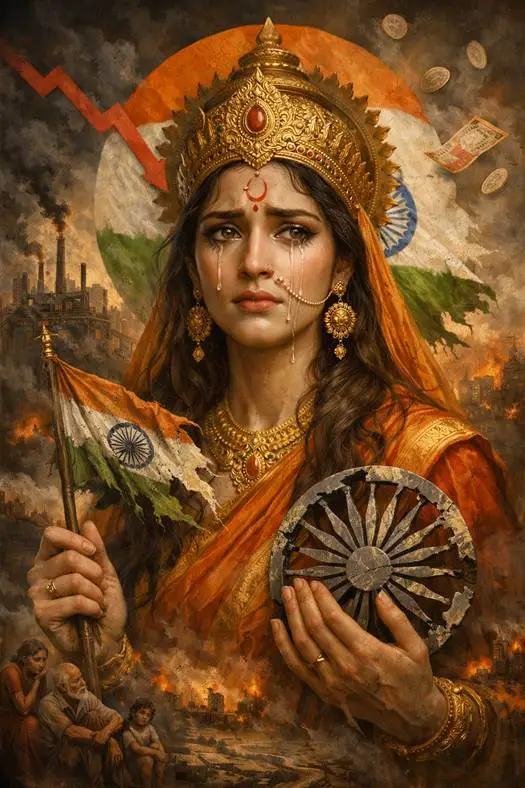
Bharat Mata in Tears as India’s Economy Unravels
Dr. Gurinder Singh Grewal
January 23, 2026
Bankim Chandra Chattopadhyay (1870s–1880s)
The idea begins with the novel Anandamath (1882).
- Bankim introduces the hymn, Vande Mataram.
- The “mother” here is the land itself, not a deity.
- Initially symbolic and poetic, not visual
Key point: Bharat Mata began as a metaphor, not as an idol.
Ideology Over Economy = Silent Economic Collapse
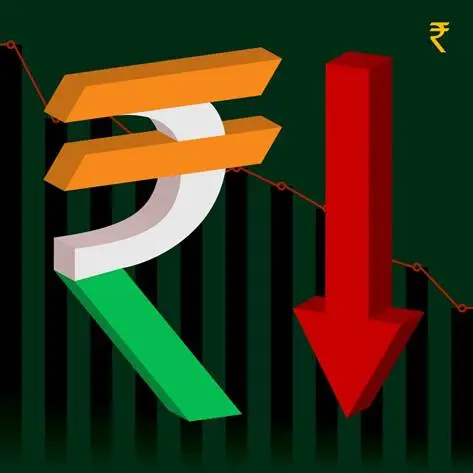
While the Bharatiya Janata Party / Rashtriya Swayamsevak Sangh government focuses on Hindu Rashtra, the Indian rupee has collapsed.
- 2014: $1 = ₹61
- 2025–26: $1 = ₹92
- Rupee value lost: ≈ 50%
This is not abstract economics.
It wipes out ordinary Indians’ savings.
What Happens to a Common Saver?
₹100 deposited in 2014 at 7% compound interest (10 years)
| Bank balance (2025–2026) | ₹196 |
| Value at today’s exchange rate | $2.18 |
| Value if rupee had stayed at ₹61 | $3.21 |
| Real loss due to rupee collapse | ≈50% |
₹196 today has the real purchasing power of only ~₹98 (2014 value)
The Message
- High interest rates do not protect savings when the currency collapses.
- Discipline and thrift are punished, not rewarded.
- Millions are being silently impoverished.
A nation can survive identity debates.
It cannot survive the destruction of household savings.
When savings die, Bharat Mata cries.
Interest Payments as % of Revenue Receipts
(How much of the government’s own income is eaten up just by paying interest on debt?)
| 2010–11 | ~13–14% (approx.) (older accounts suggest interest was ~13.4% of total revenue expenditure, which implies smaller share in revenue receipts) |
| 2014–15 | ~36–39% (multiple sources cite 36.7% or ~39% typical) |
| 2025–26 (Budget estimate) | ~37% of revenue receipts |
What This Shows
- In 2010–11, India’s interest payments accounted for a much smaller share of government revenue—roughly in the teens (~13–14%), based on audit and accounts data.
(This means less than 15 ₹ of every ₹100 in government income was going to interest.) - By 2014–15, that share had ballooned to around 36–39%, meaning over a third of government revenue went only to interest payments.
- In 2025–26 estimates, this remains high at around 37%, offering no real relief and a persistent debt burden that crowds out development and essential spending.
Why It Matters
When a government spends ~37 ₹ out of every ₹100 it earns just on interest:
- Less money is left for public services.
- Investment in growth is squeezed.
- Fiscal maneuver space shrinks.
- Ordinary citizens pay through taxes, inflation, and cuts to essential services.
Within a decade, India has shifted from manageable debt servicing to unbearable debt costs, mirroring the rupee’s fall and the loss of ordinary people’s savings.
Why This Is a Direct Result of Government Policy
This crisis is the outcome of deliberate choices:
- Weak revenue growth despite high taxation rhetoric
- Corporate tax cuts without corresponding investment revival
- Poor job creation → weak household demand → weak tax base
- Heavy reliance on borrowing instead of structural reform
- Political prioritization of ideology and spectacle over economic fundamentals
The result:
- A collapsing rupee
- Shrinking real savings
- Rising debt service burden
- Vanishing fiscal space
The Human Cost
When the government borrows to pay interest:
- Future taxpayers are trapped.
- Inflation becomes unavoidable
- Savings are silently destroyed.
- Development spending is squeezed.
- Economic insecurity becomes permanent.
Nations falter not in dramatic crashes, but as economic mismanagement suffocates growth and steadily destroys stability.
Examining the implications of heavy interest payments: What Happens When 40–45% of Government Income Goes to Interest?
Interest payments are money spent only to service past borrowing — they create no jobs, no schools, no roads, no growth.
When interest consumes 40% or more of government revenue, the state enters a fiscal danger zone.
At ~40% (Severe Stress)
- One-third to nearly half of income is pre-committed
- Government loses policy flexibility.
- Development spending is squeezed.
- New borrowing is used to:
- pay interest
- roll over old debt
- Currency weakness accelerates
- Credit ratings come under pressure.
This is fiscal suffocation, not yet collapse.
At ~45% (Debt Trap)
- Nearly every second rupee/dollar goes to creditors.
- Borrowing becomes structural, not cyclical.
- Inflation or currency depreciation becomes inevitable.
- Social spending is cut or hollowed out.
- Political instability rises
- Long-term growth collapses
This level represents a debt trap and has historically been linked to financial crises across various regions.
How India Compares with the US and Japan
Interest Payments as % of Government Revenue (Approx.)
| India (2024–26) | 37–40% (peaks near 40%) | Borrowing partly used to pay interest; weak revenue base; vulnerable currency |
| United States | 15–20% | Large debt, but strong tax base, reserve currency, global demand |
| Japan | 8–10% | Huge debt, but ultra-low interest rates, domestic financing, own currency
Why India Is Far More Vulnerable India
High interest burden + weak currency = compounding risk United States
High debt ≠ immediate danger Japan
High debt, but low servicing cost The Key Difference (Very Important) Debt size does NOT determine danger. Japan has huge debt but low interest burden. That is the red flag. The Bottom Line When a government:
it is not governing — it is refinancing failure. This is policy-made vulnerability, not fate. At 45%, the state stops investing in the future That is why Bharat Mata weeps — |
Odisha Priest Assault vs. Republic Day Rhetoric
In early January 2026, a Christian pastor in Odisha (formerly Orissa) was publicly assaulted by a mob during a prayer meeting. He was beaten, humiliated, forced to consume cow dung mixed with water, and made to chant Hindu religious slogans. He was reportedly paraded through the village and assaulted near a temple. Police intervention was delayed, and a counter-case alleging forced conversion was later filed against him.
This incident occurred just weeks before Republic Day.
On January 26 in New Delhi, India officially celebrated the Constitution with speeches invoking “unity in diversity,” secularism, and equality before law.
Why these matters
- Republic Day commemorates the Constitution, which guarantees freedom of religion, dignity, and equal citizenship.
- The Odisha incident shows a constitutional contradiction: minorities humiliated and coerced in daily life while the state projects pluralism on ceremonial platforms.
- Unity in diversity cannot be performative—it must exist beyond parade routes and televised speeches.
- When religious violence goes unpunished or is counter-criminalized, constitutional promises risk becoming symbolic rather than substantive.
In short:
Republic Day speeches spoke of unity.
Ground reality in Odisha exposed fear, coercion, and inequality.
Bharat Mata in Tears
Bharat Mata is in tears because her minorities are persecuted and tortured by those who act with confidence and often the protection—of the ruling establishment.
Bharat Mata is in tears because while the ruling class celebrates Republic Day with borrowed money, the poor struggle to survive under rising prices, shrinking savings, and vanishing opportunities.
Parades speak of pride.
Speeches invoke unity.
But a nation cannot claim moral greatness when constitutional values are violated at home and economic pain is masked by spectacle.
A mother does not weep because of criticism.
She weeps because her children are hurt, hungry, and unheard.